Introduction
Every procurement director making sourcing decisions for agri commodities eventually faces the same structural question: should we concentrate our volume with our best supplier, or should we distribute it across multiple suppliers to reduce risk?
The instinctive answer from most risk managers is “diversify.” The instinctive answer from most finance teams is “consolidate for leverage.” Both instincts are partially right and context-dependent — which is exactly why this question needs a framework rather than a default position.
Single-sourcing a critical food ingredient from a supplier in a geopolitically volatile region without a qualified backup is a continuity risk that no business case for price savings can fully justify. But multi-sourcing every commodity across three suppliers, none of whom receive enough volume to be strategic partners, guarantees higher unit prices and lower supplier investment without delivering meaningful resilience.
The decision is more nuanced than either extreme — and the right answer depends on variables specific to your commodity, your supplier market, your volume, and your risk appetite.
Section 1 — The Case for Single-Sourcing
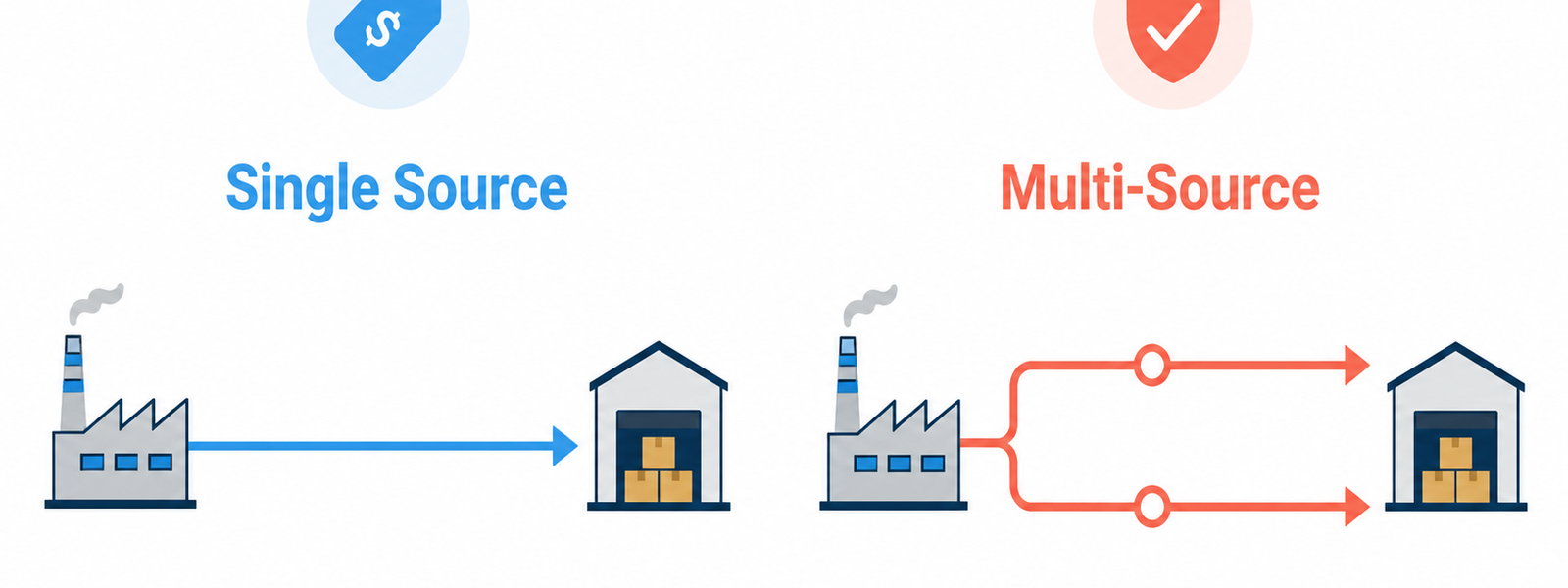
Single-sourcing — concentrating 100% of a commodity’s volume with one supplier — delivers genuine advantages when the conditions are right.
Price advantage through volume concentration
A supplier receiving your entire volume has a fundamentally different commercial relationship than one receiving 30% of it. Volume concentration creates pricing leverage, lower unit costs through production efficiency, and the supplier’s motivation to prioritise your orders during tight supply periods.
For smaller buyers who might not qualify as strategic accounts at major suppliers, concentrating volume to achieve strategic status at a mid-tier supplier often produces better commercial outcomes than splitting across several.
Quality consistency
Single-source relationships produce more consistent quality outcomes. A supplier who processes your entire volume develops a deep understanding of your specification requirements, has their production line calibrated to your needs, and has a commercial incentive to maintain that consistency. Multi-source arrangements require each supplier to meet the same specification — a requirement that is harder to enforce and inevitably produces more variation.
Management efficiency
Managing one supplier relationship well takes significant time: onboarding, qualification, performance reviews, contract management, technical collaboration, complaint resolution. Managing three relationships for the same commodity multiplies these costs without necessarily multiplying the value.
Deeper partnership development
The best supplier relationships — those that produce innovation, preferential treatment during supply crunches, and genuine collaboration on quality improvement — are built on significant, consistent volume. Single-source arrangements create the conditions for these relationships.
When single-sourcing makes sense:
– Commodity is available from multiple qualified origins (so single-supplier risk ≠ single-origin risk)
– Supplier is financially stable, operationally proven, and certified
– Your volume is sufficient to be strategically important to the supplier
– Commodity is not critical-path (a shortage causes cost, not catastrophic operational failure)
– You have a qualified backup supplier on the shelf (pre-qualified but receiving no current volume)
Section 2 — The Case for Multi-Sourcing
Multi-sourcing — distributing volume across two or more suppliers — provides resilience that single-source arrangements cannot deliver, at a cost that is worth paying when the conditions warrant.
Supply continuity insurance
The most important benefit of multi-sourcing is supply continuity. If Supplier A experiences a production failure, a quality issue, a financial crisis, or a geopolitical disruption, Supplier B can absorb volume without the delay and risk of emergency qualification.
The value of this insurance is proportional to the criticality of the commodity. For a non-critical ingredient with long shelf life and multiple available substitutes, the insurance premium of multi-sourcing may not be worth paying. For a critical production input with a unique specification, it almost certainly is.
Competitive pricing discipline
Suppliers who know they are in competition — even with a minority share of your volume — price more competitively than those with guaranteed exclusivity. A 70/30 split between a primary and secondary supplier, with explicit performance-based review of the split, maintains commercial tension without sacrificing the primary supplier relationship.
Origin diversification
For agri commodities, multi-sourcing ideally means multi-origin sourcing — qualifying suppliers in different countries. This hedges against origin-specific risks: export bans, monsoon failures, regulatory changes, and freight disruptions.
Market intelligence
Maintaining active relationships with multiple suppliers provides better market intelligence than a single-source relationship. Each supplier offers a different perspective on market conditions, pricing trends, and supply availability.
When multi-sourcing makes sense:
– Commodity is critical-path (shortage causes operational failure, not just cost)
– Single origin carries meaningful geopolitical or climate risk
– Supplier market has quality or financial stability concerns
– Volume is large enough to be strategically significant to multiple suppliers simultaneously
– Your quality specifications can be consistently met by multiple qualified suppliers
Section 3 — The Hybrid Model: Primary/Secondary Structure
For most agri commodity procurement situations, neither pure single-sourcing nor fully distributed multi-sourcing is optimal. The practical solution is a primary/secondary structure — sometimes called a “preferred/approved” or “70/30” model.
How it works:
- Primary supplier receives 70–80% of volume. They are treated as a strategic partner: regular senior-level engagement, joint quality improvement initiatives, volume commitment in exchange for pricing transparency.
- Secondary supplier receives 20–30% of volume. They maintain active supply capability, are subject to the same qualification and quality standards as the primary, and understand that their share is reviewed against performance.
The key disciplines:
- Both suppliers must be fully qualified and regularly audited — the secondary supplier is not a backup to be activated in a crisis. They are an active partner whose operational capability is continuously demonstrated.
- Volume split must be commercially meaningful for the secondary — if the secondary supplier’s share is too small to be commercially important to them, they will not invest in the relationship. A share that represents less than 5% of their production capacity is typically too small.
- Performance review must have commercial consequences — the primary/secondary split should be subject to annual review based on quality, delivery, and commercial performance. Suppliers who know the split is fixed have no incentive to compete.
- Qualification costs must be amortised — maintaining a secondary supplier requires ongoing qualification cost (audit, certification verification, sample testing, documentation management). These costs should be explicitly budgeted as a supply chain resilience investment.
Section 4 — Special Case: India as a Multi-Origin Strategy
For food and agri buyers sourcing from India, the country itself offers a form of built-in multi-sourcing that is not available from all origins.
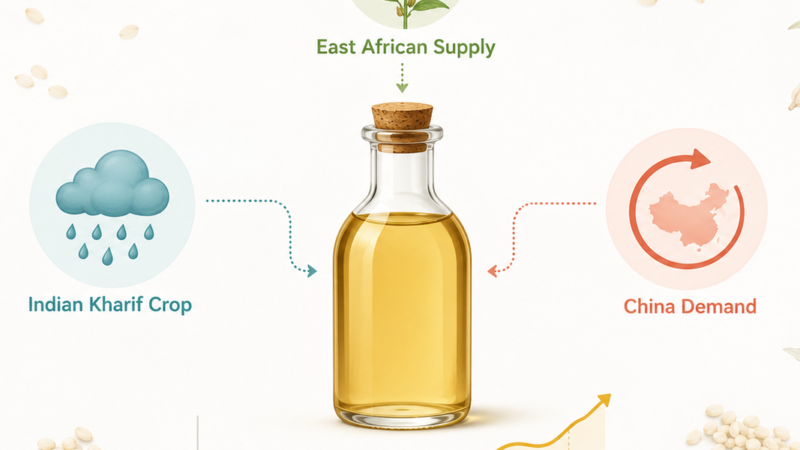
India’s agricultural geography means that a single commodity — cold pressed sesame oil, for example — can be sourced from multiple regions (Rajasthan, Gujarat, Andhra Pradesh) with different growing seasons, different climate risk profiles, and different logistics routes. A supply disruption affecting one region does not necessarily affect availability from another.
This intra-country diversification is a genuine resilience advantage that India offers relative to smaller, less geographically diverse origins. Buyers who structure their India sourcing to include multiple regional origins — or who source through an established exporter with a diversified domestic supply base — can achieve meaningful resilience without the management complexity of multi-country sourcing.
Section 5 — Decision Framework: Choosing Your Strategy
Use this framework to determine the appropriate sourcing strategy for each commodity in your portfolio.
Step 1: Rate the commodity on criticality (1–5)
– 1 = Non-critical, easily substituted, long shelf life
– 5 = Critical production input, unique specification, no immediate substitute
Step 2: Rate the supplier/origin on risk (1–5)
– 1 = Multiple qualified suppliers in stable, diversified origins
– 5 = Single viable supplier in high-risk origin
Step 3: Calculate your risk score (Criticality × Origin Risk)
| Score | Recommended Strategy |
|---|---|
| 1–5 | Single-source with pre-qualified backup |
| 6–12 | Primary/secondary hybrid (70/30 or 80/20) |
| 13–20 | True multi-source (50/50 or 60/40) with mandatory multi-origin |
| 20–25 | Multi-source + safety stock + alternative specification research |
Step 4: Review annually
Sourcing strategies should be reviewed when: your volume changes significantly, a supplier’s risk profile changes, a new supplier becomes available, or a supply disruption occurs.
Key Takeaways
- Single-sourcing delivers price leverage, quality consistency, and relationship depth — at the cost of supply continuity risk
- Multi-sourcing delivers resilience and competitive discipline — at the cost of unit price premium and management overhead
- The primary/secondary hybrid (70/30 model) captures most benefits of both for most commodity situations
- The right strategy is commodity-specific, not organisation-wide — different commodities in the same portfolio may warrant different approaches
- India’s regional agricultural diversity offers a unique multi-origin option within a single country relationship
FAQ
Q: Does multi-sourcing always cost more?
A: Not necessarily. For large volumes, the competitive tension between two suppliers can produce lower prices than single-source concentration, especially if one supplier lacks genuine competition. However, for smaller volumes, multi-sourcing typically carries a unit price premium.
Q: How many suppliers is too many?
A: For most agri commodity categories, three active suppliers is the practical maximum. Beyond three, management cost increases without proportionate resilience benefit, and no individual supplier receives enough volume to be strategically motivated.
Q: How do I qualify a secondary supplier without immediately giving them volume?
A: Qualification (factory audit, certification verification, specification approval, trial order) can be completed without committing ongoing volume. The secondary supplier understands they are being qualified for potential volume allocation.
Q: Should the supplier know about the primary/secondary structure?
A: Yes. Transparency about the split and the criteria for reviewing it creates the right commercial dynamic. Suppliers who understand that their share is performance-dependent are more likely to invest in quality and service.
Conclusion
The single-source vs. multi-source debate is a false binary. The right question is: given this commodity’s criticality and this supplier market’s risk profile, what sourcing structure best balances price, quality, and resilience?
For most agri food procurement situations, the answer is a structured primary/secondary model — one that provides the pricing and relationship benefits of concentration while maintaining the operational insurance of a qualified, active secondary.
The discipline is in maintaining both relationships properly: giving the primary enough volume to be a genuine partner, and giving the secondary enough volume to maintain their capability and motivation. That balance is where the best procurement outcomes are found.
Purolean Global supports food and agri buyers with supply strategy consultation and multi-origin India sourcing. Visit global.purolean.com
Internal Links
- → Commodity Market Intelligence: The Procurement Leader’s Guide
- → How Procurement Teams Evaluate New Supplier Markets
- → The Modern Procurement Playbook
- → 4 Pillars of Supply Chain Resilience
- → Total Cost of Ownership in Food Procurement
External Authority Links
- CIPS Procurement Knowledge — https://www.cips.org/knowledge/procurement-topics-and-skills/
- Harvard Business Review on Supply Chain Risk — https://hbr.org/topic/subject/supply-chain-management