Introduction
Sesame oil has been used in Asian cuisine for centuries. It has the highest antioxidant content of any vegetable oil, a naturally long shelf life due to its sesamol content, and a distinctive flavour that makes it irreplaceable in specific culinary applications — it cannot be substituted without fundamentally changing the product.
For importers and buyers sourcing cold pressed sesame oil for retail, food service, or industrial use, this non-substitutability is a double-edged commercial reality: it creates a loyal, premium customer base, but it also means price volatility passes through to buyers without the option of switching to an alternative. Understanding the price drivers and structuring procurement accordingly is therefore particularly important in this category.
Section 1 — The Global Sesame Market: Production and Trade
Production geography
Sesame is produced across a wide geographic belt stretching from sub-Saharan Africa through the Indian subcontinent to East Asia. The major producing countries are:
- India — the world’s largest producer of sesame seeds, accounting for approximately 25–30% of global production. Major growing states: Rajasthan, Gujarat, Uttar Pradesh, Madhya Pradesh, Andhra Pradesh, and Telangana.
- Sudan and Ethiopia — major African producers, together accounting for 20–25% of global production. African-origin sesame is primarily exported as raw seed.
- Myanmar — significant Southeast Asian producer, with a large proportion of output consumed domestically.
- China — both a major producer and a major importer; Chinese demand has a significant effect on global sesame prices.
- Tanzania, Nigeria, Burkina Faso — growing African origins.
India’s sesame oil position
India is unique in the global sesame market for its combination of: large-scale seed production, well-developed cold press extraction capability, FSSAI-regulated food safety standards, and the export infrastructure to serve international markets. For buyers seeking certified, traceable cold pressed sesame oil, India is the primary viable origin at commercial scale.
Indian sesame oil exports have grown steadily over the past decade, driven by demand from the EU, UK, Gulf, and increasingly, Southeast Asian markets for premium-grade, certified product.
Section 2 — Key Price Drivers
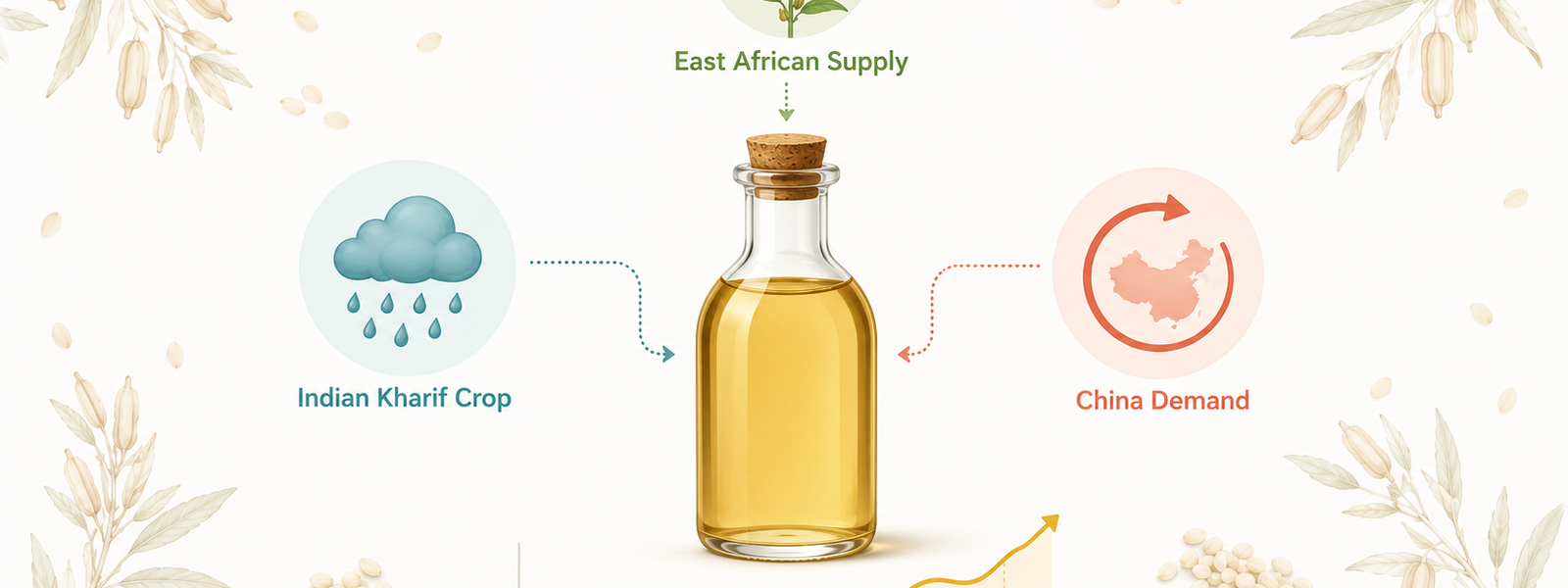
Driver 1: Indian Kharif crop production
The Indian sesame crop is predominantly a Kharif (summer/monsoon) crop, sown between June and August and harvested between September and November. The scale and quality of this crop — determined by monsoon rainfall, particularly in Rajasthan, Gujarat, and Andhra Pradesh — is the single most important annual price determinant.
A good Kharif crop → abundant seed supply → downward price pressure.
A poor Kharif crop (drought, excess rain at harvest, pest damage) → tight supply → price increase.
The Indian Meteorological Department’s monsoon forecasts (released May–June) and weekly sowing progress data (released by the Ministry of Agriculture through August) are the leading indicators to monitor.
Driver 2: Chinese buying patterns
China is both a major sesame producer and one of the world’s largest sesame importers. When Chinese domestic sesame production is below expectations, Chinese buying in the international market — particularly from India and Africa — increases significantly. A surge in Chinese import demand can tighten global sesame availability and drive prices upward within weeks.
Chinese import data (available through China Customs) is a critical monitoring signal for sesame buyers.
Driver 3: East African crop conditions
Sudan and Ethiopia together produce a significant share of global sesame. The African Rabi crop (sown October–November, harvested January–March) competes with Indian sesame in the export market. A large African crop creates downward price pressure; a poor African crop shifts demand toward Indian origin.
Driver 4: Currency movements
Indian sesame oil is priced in USD. The INR/USD rate affects Indian exporter margins and price-setting behaviour. When the rupee weakens, Indian exporters can offer lower USD prices while maintaining rupee margins — typically increasing price competitiveness. When the rupee strengthens, USD prices must rise to maintain rupee margins.
Driver 5: Oil content and quality premium
Sesame seeds are priced partly based on their oil content (typically 45–55% by weight) and quality parameters — purity, moisture content, aflatoxin levels. High-oil-content seeds from premium origins (specific Indian varieties, Sudanese white sesame) command premiums over standard grades. For cold press extraction, oil content directly affects yield and unit production cost.
Section 3 — 2025–2026 Price Outlook
Note: This represents an analytical view based on current market conditions, not a guaranteed price forecast.
Indian Kharif 2025: Monsoon forecasts for June–September 2025 indicate above-normal rainfall in key sesame-growing states (Rajasthan, Gujarat). If forecasts are accurate, the 2025 Kharif crop should be above the 2024 level — which was constrained by below-normal rainfall in some producing regions.
An above-normal 2025 crop would provide moderate downward price pressure in Q4 2025 and Q1 2026 — historically the most favourable buying window for India-origin sesame oil.
Chinese demand watch: Chinese domestic soybean oil prices and broader edible oil market conditions will influence the degree to which Chinese buyers enter the sesame market in 2025. Monitor China customs import data monthly for early signals.
Long-term structural trend: Global demand for sesame oil — particularly cold pressed, food-grade, certified-origin sesame oil — is growing faster than production is expanding. The long-term price trend is modestly upward. Price cycles occur within this trend, but the structural demand support from Asian cuisine growth in Western markets and health-food channel expansion is durable.
Section 4 — Quality Parameters Buyers Should Specify
For cold pressed sesame oil, the quality specification is more complex than for refined sesame oil. Buyers should specify and verify:
Physical and chemical parameters:
– Oil content (yield): minimum 45% from raw seed
– Colour: pale golden to amber — characteristic of sesame variety and growing region; cold pressed product should not be dark or oxidised
– Free Fatty Acids (FFA): ≤1% (indicative of seed freshness; high FFA indicates old or improperly stored seed)
– Peroxide Value: ≤10 meq/kg (oxidation indicator; lower is better)
– Moisture content: ≤0.1%
– Sesamol content: naturally present; a key quality marker for cold pressed sesame oil and a key differentiator from refined oil
Microbiological parameters:
– Total Plate Count, Yeast and Mould, E. coli, Salmonella — all to food-grade standards consistent with destination market requirements
Contaminant parameters:
– Pesticide residues — test against EU MRL or destination market equivalent
– Heavy metals — Lead, Cadmium, Arsenic, Mercury (EU food safety limits)
– Aflatoxin — particularly important for groundnut and sesame origin products; EU limit is 4 μg/kg total aflatoxin
Section 5 — Procurement Strategy for Sesame Oil Buyers
Strategy 1: Buy ahead of the Q3 price peak
The June–August period before the Kharif harvest is typically the annual price high for Indian sesame, as previous season stocks are depleted. Buyers who place significant orders in Q1–Q2 (January–June) often achieve better pricing than those who wait until Q3.
Strategy 2: Lock in Q4 pricing
Post-harvest (October–December) is when new crop sesame reaches the market and prices are typically at their annual low. Fixed-price contracts negotiated in this window and running into the following year typically lock in advantageous prices.
Strategy 3: Specify variety and origin
Indian sesame varieties differ in oil content, flavour profile, and quality consistency. Working with a supplier who can specify the variety and growing region — not just “Indian sesame oil” — provides quality assurance that generic sourcing cannot.
Strategy 4: Maintain a 60-90 day buffer stock
Given sesame oil’s excellent shelf life (natural sesamol content provides oxidative stability — shelf life of 18–24 months for properly packaged cold pressed oil), maintaining 60–90 days of stock provides meaningful protection against price spikes and supply disruptions at modest carrying cost.
Key Takeaways
- Indian Kharif crop conditions (monsoon, sowing progress) are the most important annual price driver for sesame oil — monitor June–September closely
- Chinese demand surges can tighten global sesame availability quickly — watch Chinese import data monthly
- Q4 (October–December) post-harvest is historically the best window for annual contract negotiation for India-origin sesame oil
- Specify quality parameters explicitly (FFA, peroxide value, sesamol content) — these differentiate genuinely cold pressed product from refined or adulterated alternatives
- Cold pressed sesame oil’s natural shelf life (18–24 months) makes buffer stock a cost-effective risk management tool
FAQ
Q: What is the difference between cold pressed sesame oil and toasted sesame oil?
A: Cold pressed sesame oil is extracted from raw sesame seeds at low temperature — it has a pale golden colour and mild flavour. Toasted sesame oil is made from roasted seeds — it has a dark amber colour and strong, nutty flavour used as a flavouring in Asian cuisine. They are different products serving different applications.
Q: Is Indian sesame oil quality comparable to Japanese or Korean sesame oil?
A: Premium Indian cold pressed sesame oil from certified producers is quality-comparable with the best East Asian origins. The key differentiator is variety and processing quality — not simply origin.
Q: How does sesame oil’s natural stability compare to other cold pressed oils?
A: Sesame oil’s sesamol and sesamin content gives it exceptional oxidative stability relative to most other cold pressed oils. This translates into an 18–24 month shelf life for properly packaged product — significantly longer than cold pressed coconut, groundnut, or sunflower oil.
Q: What certifications should I require for sesame oil from India?
A: At minimum: FSSAI, ISO 22000, HACCP. Additionally for specific markets: organic (APEDA accredited), non-GMO, halal (for Gulf markets), and kosher where required.
Conclusion
Sesame oil procurement rewards buyers who understand the crop cycle, monitor the key price drivers, and structure their purchasing to take advantage of seasonal price patterns rather than react to them.
India is the premier origin for certified cold pressed sesame oil — combining production scale, quality infrastructure, and export capability that few other origins can match. For buyers seeking food-grade, traceable, certified product, India’s position in this market is strong and likely to strengthen further as international demand grows.
The opportunity for well-prepared buyers is to lock in supply relationships and pricing structures during the crop-year’s price lows — rather than competing for available product during the supply-constrained highs.
Purolean Global exports certified cold pressed sesame oil from India — FSSAI, ISO 22000, HACCP, and GMP certified. Request a sample at global.purolean.com
Internal Links
- → Cold Pressed Oils: The Complete Buyer’s Guide
- → Coconut Oil Price Outlook 2025–2026
- → Commodity Market Intelligence: The Procurement Leader’s Guide
- → India as a Global Food Export Powerhouse
- → Total Cost of Ownership in Food Procurement
External Authority Links
- USDA Foreign Agricultural Service — Oilseeds — https://www.fas.usda.gov/commodities/oilseeds
- SEAOIL India Sesame Export Data — https://apeda.gov.in/apedawebsite/