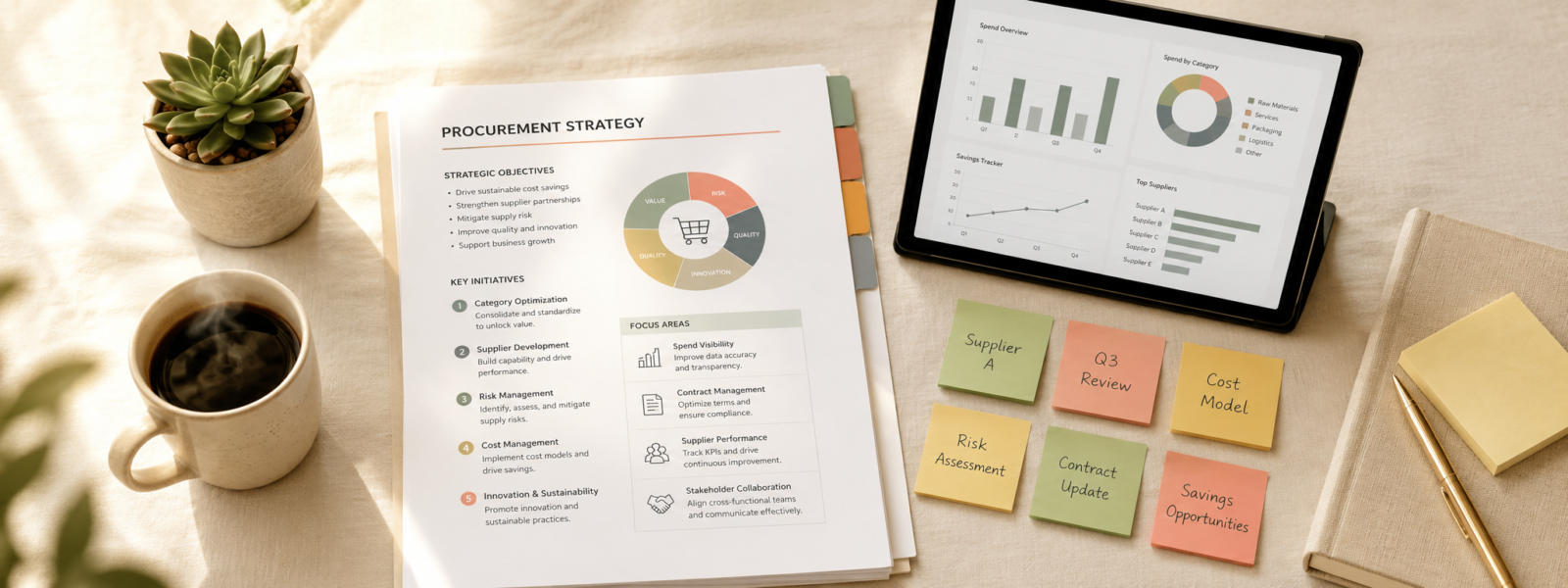
Introduction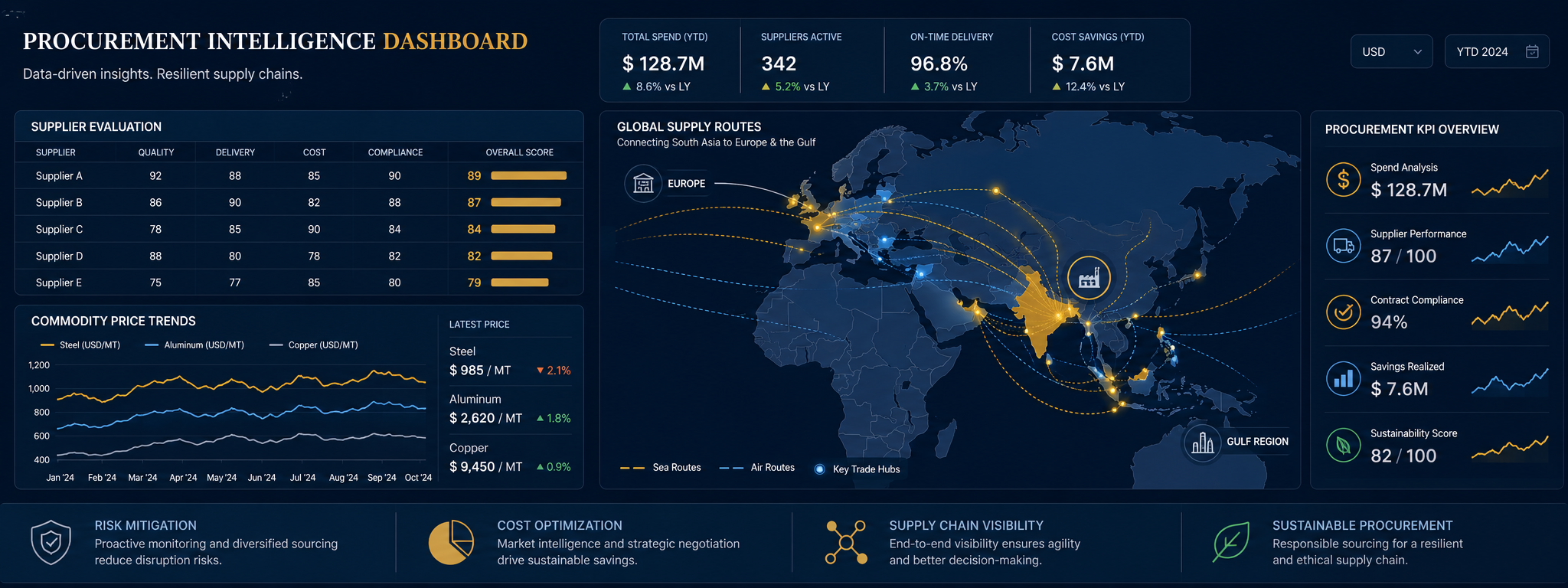 Strategic procurement demands more than price negotiation — it requires frameworks, KPIs, and disciplined supplier management
A decade ago, the procurement function in most food and agri businesses was relatively straightforward. You identified suppliers, compared prices, negotiated terms, and placed orders. The assumption was that supply would arrive, and the job was to make it arrive cheaply.
That assumption no longer holds.
The past five years have delivered a sustained sequence of supply chain disruptions — a global pandemic, regional conflicts affecting shipping routes, extreme weather events devastating harvests, and geopolitical realignments reshaping which countries trade with whom. Each event has exposed procurement teams that were optimised for cost rather than resilience.
The organisations that fared best were not those with the lowest invoice prices. They were those with the strongest supplier relationships, the deepest market intelligence, and the most thoughtful risk management frameworks.
This playbook is designed for procurement managers and directors responsible for agri and food commodity sourcing — particularly those buying from emerging market suppliers across South Asia, the Gulf, and global trade corridors. It sets out the strategic principles, operational frameworks, and performance metrics that define best-in-class procurement in 2025 and beyond.
Section 1 — The Strategic Shift: From Cost Centre to Value Engine
The most important reframe in modern procurement is understanding what the function is actually for.
Procurement is not a cost centre. It is a value engine. The distinction matters because it changes every decision that follows.
A cost centre mentality optimises for the lowest price on each transaction. A value engine mentality optimises for the total value delivered across the supplier relationship — which includes price, but also quality consistency, supply security, flexibility, compliance reliability, and the strategic information that a well-managed supplier provides about market conditions.
The three dimensions of procurement value:
1. Commercial value — the direct financial impact of sourcing decisions, including price, payment terms, volume commitments, and total cost of ownership. This is the dimension most procurement teams measure. It is necessary but insufficient.
2. Operational value — the contribution of procurement to supply continuity, lead time reliability, quality consistency, and regulatory compliance. A supplier who delivers 5% cheaper but fails audit twice a year costs far more than their invoice price.
3. Strategic value — the intelligence, relationships, and market access that procurement decisions create or foreclose. Buying from the right supplier in the right market at the right time is a strategic decision with implications that compound over years.
Best-in-class procurement teams measure all three dimensions. Most teams only formally measure the first.
Section 2 — Supplier Segmentation: Not All Suppliers Are Equal
One of the most impactful frameworks a procurement team can implement is supplier segmentation — the practice of deliberately categorising suppliers by their strategic importance and treating each segment differently.
The most widely used model is a two-axis matrix assessing
supply risk against
value of spend:
| Segment |
Supply Risk |
Value |
Strategy |
| Strategic |
High |
High |
Deep partnership, joint planning, executive relationships |
| Leverage |
Low |
High |
Volume consolidation, competitive tendering, price discipline |
| Bottleneck |
High |
Low |
Risk mitigation, dual sourcing, buffer stock |
| Non-critical |
Low |
Low |
Simplify, automate, consolidate |
For agri and food commodity buyers, the most important segment to manage carefully is
Bottleneck suppliers — those providing speciality commodities (such as cold pressed oils, specific produce varieties, or certified organic ingredients) where alternative sources are limited and supply disruption would halt production.
These suppliers warrant proactive relationship investment regardless of spend volume. The cost of losing them is rarely visible on a procurement dashboard until it is too late.
Section 3 — Total Cost of Ownership: The Real Price of a Supplier
Invoice price is a poor proxy for procurement value. The actual cost of a sourcing decision includes a range of factors that never appear on an invoice.
Components of Total Cost of Ownership (TCO) in agri food procurement:
- Unit price — the baseline cost per kg, litre, or unit
- Freight and logistics — variable by Incoterm, route, mode, and season
- Customs and duties — determined by HS code, country of origin, and destination regulations
- Quality failure costs — product rejected at border, returned by retailer, or recalled from market
- Compliance costs — cost of audit, certification maintenance, documentation management
- Inventory carrying costs — capital tied up in stock, storage costs, obsolescence risk
- Switching costs — the cost of transitioning to a new supplier if the current one fails
- Relationship investment — management time spent on supplier oversight
A supplier who quotes 8% below market rate but requires intensive quality management, generates frequent documentation errors, and has unreliable lead times may have a TCO 15–20% higher than a premium-priced, high-quality alternative.
Procurement teams that evaluate TCO rather than invoice price make fundamentally better decisions — and can justify paying for quality to internal stakeholders with credible financial modelling.
Section 4 — The Supplier Evaluation Framework
When assessing a new agri or food commodity supplier, procurement teams need a structured evaluation process that covers the full risk surface, not just price and product quality.
Six dimensions of supplier evaluation:
1. Financial stability — Is the supplier financially sound? A supplier facing cash flow pressure may cut corners on quality, fail to maintain certifications, or disappear mid-contract.
2. Regulatory compliance — Does the supplier hold the certifications required by your destination market? For food products exported to the UK, EU, or UAE, this typically includes FSSAI, ISO 22000, HACCP, GMP, and any destination-specific approvals (e.g., ESMA for UAE, DEFRA compliance for UK).
3. Production capacity and scalability — Can the supplier meet your current volumes? Can they scale if your demand grows? Have they demonstrated the ability to manage multiple large buyers simultaneously?
4. Quality management systems — What is their internal quality control process? Do they conduct batch testing? Can they provide lab reports? What is their claims and returns policy?
5. Supply chain transparency — Can they tell you where their raw materials come from? For agricultural products, traceability to farm level is increasingly a buyer and regulatory requirement.
6. Communication and responsiveness — How quickly do they respond to enquiries? How clearly do they communicate on lead times, stock availability, and documentation? This is a strong predictor of how they will perform when problems arise.
Formalise this evaluation in a supplier scorecard with weighted criteria. Weight regulatory compliance and financial stability more heavily than price for strategic suppliers.
Section 5 — Contract Strategy and Commercial Terms
Once a supplier passes evaluation, the commercial terms you negotiate determine how the relationship functions in practice.
Key terms to negotiate in agri commodity supply contracts:
- Price review mechanism — fixed price, indexed to commodity benchmark, or quarterly renegotiation? Commodity-linked pricing protects both parties in volatile markets.
- Minimum and maximum quantities — define volume commitments that give the supplier planning certainty while preserving your flexibility.
- Lead times and delivery windows — specify acceptable lead times and the consequence of failure to deliver on time.
- Quality specifications — define measurable quality parameters (moisture content, acidity, microbial count, etc.) rather than vague qualitative terms.
- Audit rights — reserve the right to audit supplier facilities on reasonable notice. This is standard practice for regulated food supply chains.
- Force majeure provisions — define which events excuse non-performance and what the notification obligations are.
- Certification maintenance — require the supplier to maintain specified certifications throughout the contract term and notify you of any certification lapse.
Section 6 — Risk Management in Food Procurement
Supply chain risk in food and agri procurement is multi-dimensional. A robust risk management approach identifies risks at each tier of the supply chain and prepares mitigation strategies before disruption occurs.
The four primary risk categories:
Supply risk — the risk that a supplier cannot deliver (crop failure, factory shutdown, financial distress, regulatory suspension). Mitigation: dual sourcing, safety stock, supplier financial monitoring.
Quality risk — the risk that product does not meet specifications or regulatory requirements. Mitigation: incoming quality inspection, third-party lab testing, supplier audit programme.
Regulatory risk — the risk that regulatory changes in the origin or destination country affect the ability to trade. Mitigation: trade intelligence monitoring, advance documentation review, working with specialist customs brokers.
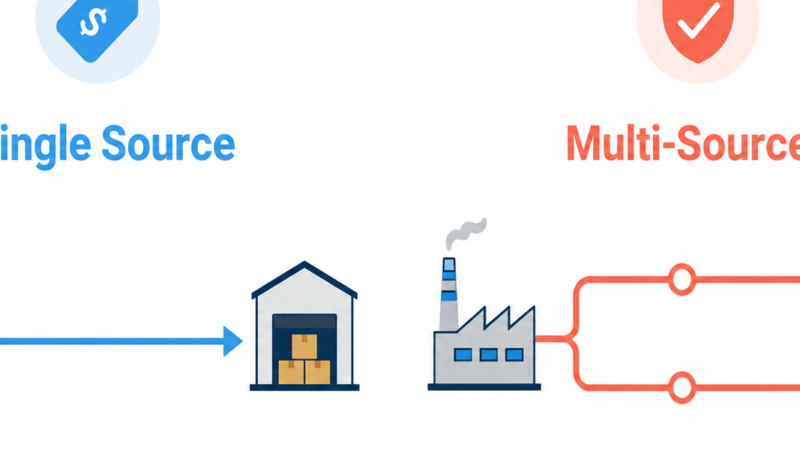
Concentration risk — the risk of over-dependence on a single supplier, country, or trade corridor. Mitigation: deliberate diversification across suppliers and geographies.
Section 7 — Performance Management: Procurement KPIs That Matter
Procurement performance measurement should capture value across all three dimensions — commercial, operational, and strategic.
Essential KPIs for food and agri procurement teams:
| KPI |
What It Measures |
Target |
| Cost Savings vs. Budget |
Commercial value delivered |
3–5% annually |
| Supplier On-Time Delivery |
Operational reliability |
>95% |
| Quality Rejection Rate |
Quality management effectiveness |
<1% |
| Supplier Audit Compliance |
Regulatory risk exposure |
100% compliant |
| Procurement Cycle Time |
Process efficiency |
Benchmark by category |
| Spend Under Management |
Procurement coverage |
>85% of addressable spend |
| Supplier Risk Score |
Portfolio risk level |
Monitored quarterly |
| Lead Time Variance |
Supply predictability |
<10% variance |
Review these metrics quarterly with your supplier base. Share relevant performance data with strategic suppliers — transparency builds the trust that makes problem resolution faster.
Practical Takeaways
- Segment your supplier base — apply strategic partnership investment where supply risk is high, not just where spend is high.
- Calculate TCO, not invoice price — model the full cost of each supplier relationship before making sourcing decisions.
- Build a formal evaluation scorecard — standardise how you assess new suppliers across financial, regulatory, quality, and operational dimensions.
- Negotiate substance, not just price — the non-price terms in your supply contracts determine how risks are allocated when things go wrong.
- Monitor the right KPIs — measure operational and strategic performance, not just cost savings.
Conclusion
The procurement function has never been more consequential. In a world of persistent supply chain volatility, the quality of a company’s sourcing decisions determines not just its cost structure but its operational resilience, regulatory compliance, and competitive positioning.
Procurement teams that operate as strategic business partners — deploying rigorous supplier evaluation, sophisticated risk management, and evidence-based performance measurement — will consistently outperform those that treat buying as a transactional activity.
The agri and food commodity markets in particular reward procurement discipline. Markets are volatile, regulations are complex, and the consequences of supply failure are immediate and visible. The organisations that get procurement right in these markets do not just avoid crises — they build sustainable competitive advantage.
FAQ Section
Q: What is the most important thing a procurement team can do to improve supplier performance?
A: Move from transactional to relational supplier management. Share forecasts with strategic suppliers, conduct quarterly reviews, and invest in the relationship before you need it.
Q: How many suppliers should we have for a key commodity?
A: For commodities where supply risk is high, maintain at least two qualified suppliers — a primary and a secondary. This is dual sourcing and is the most effective hedge against single-supplier failure.
Q: How often should supplier contracts be renegotiated?
A: Annual review is standard for most agri commodity contracts, with a mid-year price review for volatile commodities. Strategic partnership contracts may run two to three years with built-in adjustment mechanisms.
Q: What certifications should I require from a food supplier in India?
A: At minimum: FSSAI registration, ISO 22000, HACCP, and GMP. For specific markets: organic certification (EU/UK), ESMA approval (UAE), halal certification where relevant. See our guide to FSSAI export certification for detailed requirements.
Q: How do I calculate total cost of ownership for a supplier?
A: Start with invoice price and add freight, duties, quality failure costs, compliance management costs, and inventory carrying costs. Subtract the value of any payment term benefits (e.g., extended credit). The result is a more accurate basis for supplier comparison than price alone.
Key Takeaways
- Modern procurement creates value across three dimensions: commercial, operational, and strategic.
- Supplier segmentation ensures that relationship investment is allocated where supply risk is greatest.
- Total cost of ownership is a more accurate decision basis than invoice price.
- Formal supplier evaluation frameworks reduce the risk of selecting under-qualified suppliers.
- Risk management in food procurement requires proactive planning across supply, quality, regulatory, and concentration risks.
- The right KPIs measure operational reliability and strategic performance, not just cost savings.
Purolean Global is a certified agri and food export company based in India, supplying premium commodities — including cold pressed coconut, groundnut, and sesame oils — to importers and distributors across the UAE, UK, and Europe. Contact us to discuss your sourcing requirements.
CTA: Subscribe to the Purolean Global Trade Intelligence newsletter for weekly procurement insights, commodity market updates, and export intelligence.
→ [Subscribe at purolean.com]