Introduction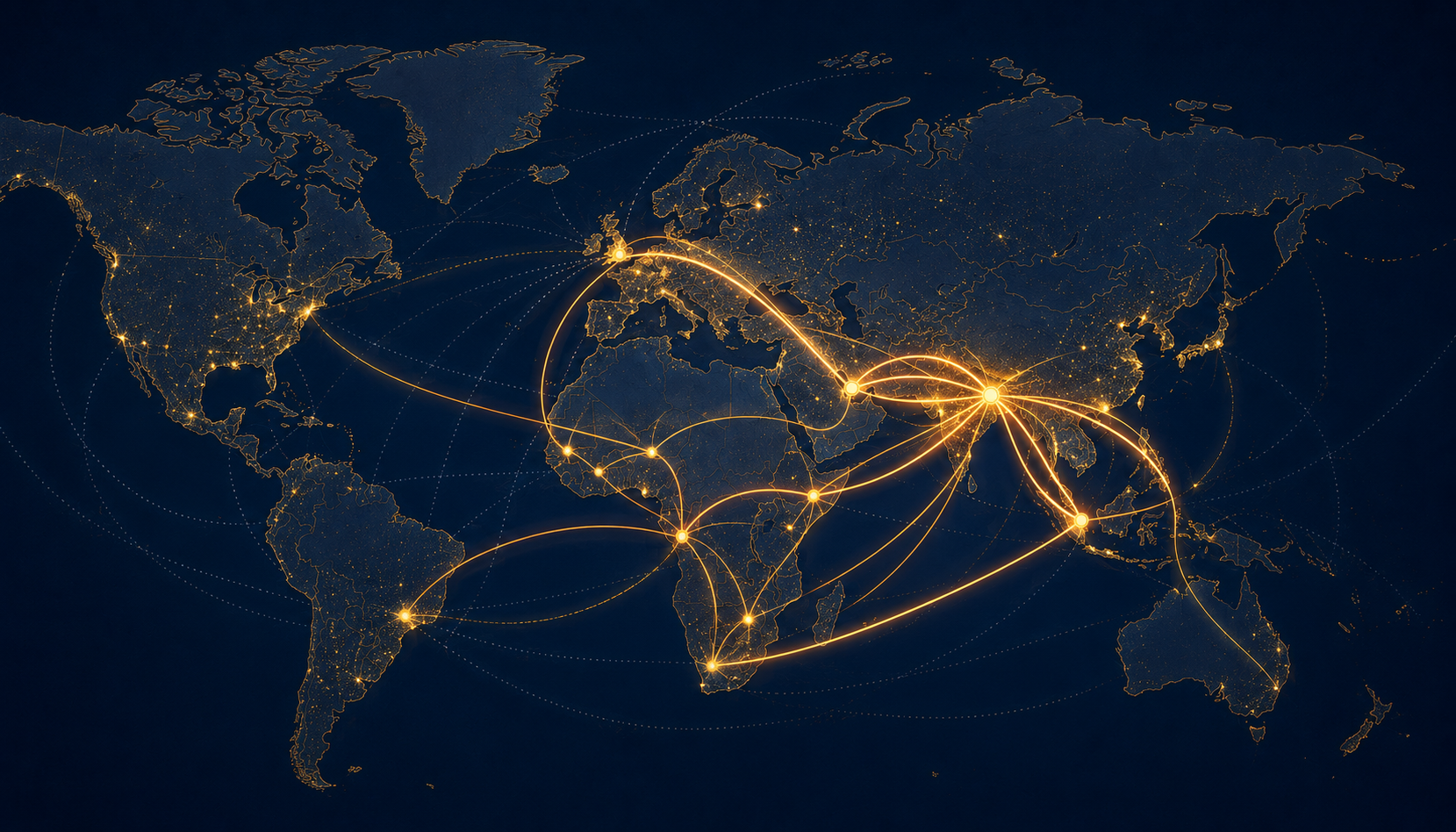 South-South trade now accounts for over 50% of global agri trade — India sits at the centre of this shift
The dominant narrative in global trade for much of the twentieth century was North-South: developing economies exported raw materials northward to wealthy industrialised countries, which manufactured finished goods and sold them back. This model shaped trade policy, investment flows, and supply chain design across generations.
That model has not disappeared — but it is being increasingly supplemented, and in some sectors replaced, by a different pattern: South-South trade, in which emerging and developing economies trade directly with each other, bypassing the Northern intermediary entirely.
For global food trade, this shift has profound implications. India — the world’s largest democracy, the fifth-largest economy, and one of the world’s most productive agricultural nations — is at the centre of this transformation. Its food exports are growing in volume, improving in quality, and reaching a wider range of destinations than at any point in its history.
For importers and procurement leaders in the UAE, UK, and Europe, understanding this trend is not merely academic. It illuminates where food supply is becoming more reliable and better-certified, where new product categories are becoming commercially viable, and where the sourcing landscape of 2030 is being built today.
Section 1 — What South-South Trade Means for Food Supply Chains
South-South trade in food and agriculture has grown from approximately 30% of global agri trade in 2000 to over 50% today, according to UNCTAD data. This growth has been driven by several converging forces: Rising middle classes in emerging economies: as incomes rise across South Asia, Southeast Asia, the Gulf, and Africa, domestic food demand grows and diversifies. Countries that were once almost exclusively agricultural exporters become significant food importers as their urban populations demand more processed, packaged, and diverse food products. Agricultural productivity improvements: investment in agricultural technology, irrigation, and supply chain infrastructure across India, Brazil, Southeast Asia, and sub-Saharan Africa has increased production capacity in ways that were not anticipated by previous trade forecasts. Quality infrastructure development: emerging economy food exporters have invested significantly in certification infrastructure — food safety labs, international standard adoption, export regulatory frameworks — enabling them to meet the quality requirements of demanding destination markets. Trade facilitation improvements: the reduction of trade barriers, improvement of customs procedures, and development of digital trade documentation systems have reduced the friction costs of South-South trade, making smaller-volume, higher-value trades commercially viable. Geopolitical realignment: the post-2020 reassessment of supply chain concentration has accelerated demand for alternatives to traditional Northern supply chains, benefiting emerging market exporters who had invested in quality infrastructure.Section 2 — India’s Position in South-South Food Trade
- A major exporter of agricultural commodities to emerging market destinations (Bangladesh, Sri Lanka, Nepal, Africa, Southeast Asia)
- A growing exporter of higher-value food products to developed market destinations (UAE, UK, Netherlands, USA)
- An established re-export hub through Indian port infrastructure for commodities from adjacent agricultural regions
| Category | India’s Global Share | Primary Destinations |
|---|---|---|
| Rice | ~40% of global rice exports | UAE, Bangladesh, Nigeria, Saudi Arabia, Senegal |
| Spices | ~40% of global spice exports | USA, China, Vietnam, UAE, UK |
| Marine products | ~15% of global seafood exports | USA, China, Southeast Asia, EU |
| Buffalo meat | ~25% of global buffalo meat exports | Vietnam, Malaysia, Egypt, Indonesia |
| Processed foods | Growing | UAE, UK, USA, Gulf states |
| Edible oils (cold pressed) | Growing | UK, EU, UAE, USA |
Section 3 — The Quality Trajectory: Why India Is Getting Better as a Source
One of the most important trends for international buyers to understand is that the quality trajectory of Indian food exports is strongly positive. The supply chain that buyers encounter in 2025 is meaningfully different from the one that existed in 2015 — and will be different again in 2030. Key quality improvement drivers: FSSAI modernisation: the Food Safety and Standards Authority of India has progressively aligned Indian food safety standards with Codex Alimentarius international standards. This regulatory convergence reduces the compliance gap between Indian export products and international destination market requirements. Certification infrastructure expansion: the number of food processing facilities in India holding internationally recognised certifications (ISO 22000, HACCP, GMP) has grown substantially. APEDA — the government’s agricultural export development body — has run sustained programmes to support exporters in achieving international certification. Testing infrastructure: the network of NABL-accredited food testing laboratories in India has expanded significantly, providing Indian exporters with access to internationally recognised, independently verifiable food safety and quality testing. Private investment in export infrastructure: India’s growing export volumes have attracted private investment in cold chain infrastructure, packaging facilities, and export processing zones — reducing the logistical quality gap between Indian agricultural exports and those from more developed agricultural origins. Buyer-driven quality pressure: as Indian food exports reach more sophisticated destination markets (UK retail, European food manufacturers, UAE modern trade), buyer quality requirements have driven supply chain quality improvements in a virtuous cycle.Section 4 — The UAE as a Hub in India’s Export Architecture
The UAE deserves particular attention as a node in India’s South-South trade architecture. The UAE is not simply a destination for Indian food exports — it is a strategic intermediary. India’s food exports to the UAE serve multiple functions simultaneously: Direct consumption: the UAE’s large South Asian expatriate community — approximately 40% of the total population — represents sustained, high-volume demand for Indian food products including rice, spices, edible oils, fresh produce, and processed food. Re-export distribution: the UAE’s free trade zone infrastructure and its strategic geographic position make it a major re-export hub for Indian food products reaching markets across the Gulf, Africa, and South Asia. Products entering the UAE under re-export terms benefit from the UAE’s trade facilitation infrastructure. Market access testing: for Indian exporters targeting European and North American markets, UAE market entry provides a lower-barrier proving ground for export-quality production, certification compliance, and logistics management before committing to the higher requirements of EU and UK market entry. For buyers in the UK and Europe, this means that Indian food exporters with a track record in the UAE market have already demonstrated export competence — a relevant due diligence signal.Section 5 — Implications for Global Buyers
The rise of South-South trade, and India’s central role in it, has several practical implications for procurement teams and importers in the UAE, UK, and Europe. Implication 1 — India’s export supply is structural, not cyclical India’s food export growth is the result of structural investments in production, quality, and logistics infrastructure. It is not a short-term price play. Buyers who build sourcing relationships with Indian exporters now are accessing a supply base that will be larger, better-certified, and more logistically capable in five years than it is today. Implication 2 — Competition for quality Indian supply will increase As South-South trade grows and emerging market buyers develop more sophisticated food sourcing requirements, competition for premium Indian food exports — organic, cold pressed, FSSAI-certified, ISO-compliant — will intensify. Buyers who qualify reliable Indian suppliers now, before this intensification, will have relationship advantages that late entrants will struggle to replicate. Implication 3 — Regulatory convergence reduces future compliance friction India’s progressive alignment of food safety standards with international norms — Codex, EU Regulation, UK Food Standards — means that the regulatory friction costs of Indian food imports will decline over time. Buyers already trading with compliant Indian exporters will benefit from this improvement without needing to change their supply base. Implication 4 — FTA completion will change the economics The India-UK Free Trade Agreement and the India-EU FTA (both under negotiation as of 2025) will, when concluded, reduce tariff barriers for Indian food products entering the UK and EU. Buyers who have established sourcing relationships before FTA completion will benefit from improved economics without having to build new supply chains.Practical Takeaways
- South-South trade is structural — India’s food export growth reflects permanent infrastructure investment, not a short-term price opportunity.
- India’s quality trajectory is positive — the supply you access today is better than five years ago and will be better again in five years.
- Competition for premium Indian supply is increasing — early qualification of reliable suppliers creates durable advantages.
- UAE relationships are a quality signal — Indian exporters with established UAE track records have demonstrated export competence.
- Monitor FTA progress — the India-UK and India-EU FTA negotiations will materially change the economics of Indian food imports when concluded.
Conclusion
South-South trade is not a trend to be observed from a distance. It is a structural shift in global food supply chain architecture that is creating new opportunities and new competitive dynamics for buyers in every part of the world. India is at the centre of this shift — growing its food export volumes, improving its quality infrastructure, and deepening its trade relationships with key destination markets. For importers and procurement leaders in the UAE, UK, and Europe, the strategic question is not whether to engage with India’s food export sector, but how to engage with it effectively and how soon. The organisations that answer that question proactively will build supply relationships that strengthen over time, benefit from improving quality and economics, and position themselves advantageously as the competitive landscape for premium food sourcing intensifies.FAQ Section
Q: What is South-South trade and why does it matter for food procurement? A: South-South trade refers to trade between developing and emerging economies, as distinct from North-South trade between rich and developing nations. It matters for food procurement because it reflects the growing capability of emerging market food exporters — including India — to supply international markets with high-quality, certified food products at competitive prices. Q: How has India’s food export sector changed in the past decade? A: India’s food exports have approximately doubled in value over the past decade. More importantly, the quality infrastructure has improved substantially — more exporters hold international certifications, testing infrastructure is stronger, and the regulatory framework has been modernised. Premium categories including cold pressed oils, organic spices, and certified processed foods have grown fastest. Q: Will the India-UK Free Trade Agreement make Indian food imports significantly cheaper? A: The FTA is expected to reduce tariff barriers on a range of Indian food products entering the UK, which would reduce landed cost for buyers. The extent of the reduction depends on the tariff schedule agreed. Some categories currently face meaningful tariff barriers; others are already at low or zero rates. Q: Is India’s agricultural sector vulnerable to climate change? A: Yes — as is every agricultural system globally. India’s geographic diversity (multiple agro-climatic zones) provides some resilience against single-event climate impact. The Indian government has invested significantly in drought-resistant crop varieties, irrigation infrastructure, and agricultural adaptation programmes. For buyers, geographic diversification within India — sourcing from different regional suppliers — provides additional resilience. Q: How do I find Indian food exporters that are engaged in South-South trade at scale? A: APEDA’s registered exporter database is the most reliable starting point. Exporters with established track records in multiple international markets — UAE, UK, EU simultaneously — have demonstrated the operational capability and quality consistency required for South-South and North-South export scale.Key Takeaways
- South-South trade now accounts for over 50% of global agri trade by volume, up from 30% in 2000.
- India is a central player — exporting to 150+ countries across commodity, value-added, and premium food categories.
- India’s quality infrastructure is on a strongly positive trajectory, driven by FSSAI modernisation, certification expansion, and buyer-driven quality pressure.
- The UAE serves as a strategic intermediary in India’s food export architecture — and a proven market for exporters targeting UK and EU.
- Pending FTA completion (India-UK and India-EU) will further improve the economics of Indian food imports.
Purolean Global exports premium agri and food products from India to importers and distributors across the UAE, UK, and Europe. We are a certified, established exporter contributing to India’s growing role in global food trade. CTA: Subscribe to the Purolean Global Trade Intelligence newsletter for weekly analysis of global food trade trends. → [Subscribe at purolean.com]