Introduction
Trade route vulnerabilities and geopolitical realignment are now permanent factors in food procurement — Purolean Global Trade Intelligence
Supply chain professionals have always understood that the world is not a frictionless marketplace. But until recently, many organisations operated as if geopolitical events were exceptional, short-lived disruptions — crises to be managed reactively rather than risks to be managed proactively.
That assumption has been thoroughly dismantled.
The period from 2020 to 2025 produced a near-continuous sequence of geopolitical events with direct supply chain consequences: the US-China trade confrontation, Brexit’s reshaping of UK-EU food trade flows, the pandemic-driven collapse of global logistics capacity, regional conflicts disrupting key shipping routes, and the accelerating use of sanctions as a policy instrument. Each event individually was disruptive. Collectively, they have produced a structural shift in how global food trade operates.
For procurement managers, supply chain directors, and importers, geopolitical risk is no longer a tail risk — something unlikely but worth insuring against. It is a continuous operating condition that must be embedded in supplier strategy, sourcing decisions, and risk frameworks.
Section 1 — How Geopolitical Events Translate Into Supply Chain Disruption
Understanding the mechanics of how geopolitical events affect supply chains is essential to managing the risk intelligently. The transmission channels are varied and often non-obvious.
Direct trade restrictions — sanctions, export bans, import quotas, and tariffs directly restrict which goods can flow between which countries. When a country imposes export restrictions on a food commodity (as India has done with rice and onions in recent years), buyers in destination markets face immediate supply shortages and price spikes, regardless of their relationship with their supplier.
Shipping route disruption — conflicts or security incidents in key maritime passages create route diversions, transit delays, and freight rate surges. Approximately 12–15% of global trade passes through any given major chokepoint. When a major route is compromised, the ripple effects on freight rates and lead times are global.
Port and logistics congestion — geopolitical events trigger surges in demand for alternative routes and ports, creating congestion at facilities that were not designed for the additional volume. Lead times that were predictable under normal conditions become highly variable.
Currency and payment disruption — sanctions and diplomatic ruptures affect the ability to transfer funds between countries, creating payment delays or — in extreme cases — making certain transactions impossible. For agri commodity buyers, this can translate into delayed shipments or supplier instability.
Input cost inflation — energy prices, fertiliser costs, and agricultural input prices are all sensitive to geopolitical events. A conflict that disrupts energy markets will — with a lag of one to two growing seasons — show up as higher commodity prices for food buyers worldwide.
Section 2 — The Key Geopolitical Risk Vectors for Food Supply Chains in 2026
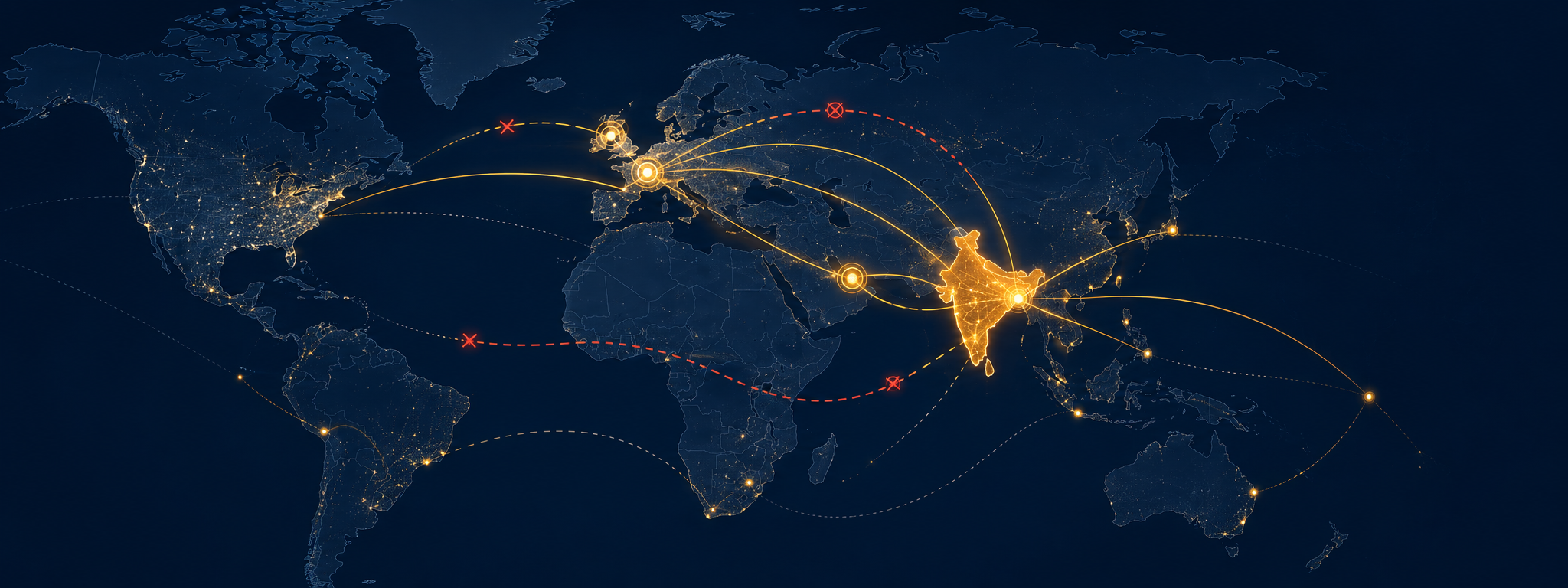
Several specific geopolitical dynamics are shaping food supply chain risk in 2025 and are expected to remain relevant over the medium term.
The India-China relationship — India is a major exporter of agricultural commodities including spices, oils, rice, and processed foods. The strategic competition between India and China, and India’s growing diplomatic alignment with Western economies, is reshaping trade flows and creating new corridors while closing others.
Gulf region stability — the UAE, Saudi Arabia, and other Gulf states are major importers of food products and serve as re-export hubs for wider regional distribution. Any instability affecting Gulf trade infrastructure has immediate downstream effects for food importers and distributors in the region.
Russia-Ukraine conflict continuity — while India’s agri exports are not directly affected, the ongoing conflict has suppressed global wheat and sunflower oil supply, diverting demand toward alternative sources including India. Indian sesame, groundnut, and coconut oil exports have benefited from European buyers seeking alternatives to Ukrainian sunflower oil — a demand shift that may prove durable.
EU-India Free Trade Agreement negotiations — ongoing negotiations between the EU and India, if concluded, would materially reduce tariff barriers on Indian agri exports to Europe, accelerating trade flows and creating new import opportunities for European buyers.
UK post-Brexit trade policy — the UK is actively building bilateral trade relationships outside the EU framework, including with India. The UK-India Free Trade Agreement under negotiation has significant implications for food import costs and regulatory requirements.
Section 3 — Supplier Country Risk: Assessing Where You Source
Every sourcing decision involves a country risk component that operates independently of the individual supplier’s quality and reliability. A well-managed supplier in a high-risk country may be a greater supply chain liability than a moderately-managed supplier in a stable, low-risk origin.
Country risk dimensions for food procurement:
Political stability — the risk of government policy changes, export restrictions, or disruptions to regulatory systems. Countries with stable, business-oriented trade policies provide more predictable sourcing environments.
Trade relationship with destination markets — the quality of the trade relationship between the origin country and the buyer’s destination market. Preferential trade agreements, mutual recognition of certifications, and strong diplomatic ties reduce regulatory friction.
Infrastructure reliability — the reliability of port, logistics, and cold chain infrastructure in the origin country. Infrastructure failures create delays regardless of supplier performance.
Climate and agricultural risk — the vulnerability of the origin country’s agricultural system to weather events, water scarcity, and climate-related disruption.
India scores well on several of these dimensions: it has a stable democratic government with a long-term commitment to export promotion, growing trade relationships with the UK and EU, improving port infrastructure, and agricultural resilience built on geographic and crop diversity. This makes it a compelling sourcing origin for food buyers seeking to reduce country concentration risk away from more geopolitically exposed alternatives.
Section 4 — The Strategic Response: Building Geopolitical Resilience
Understanding geopolitical risk is necessary but insufficient. The value lies in translating that understanding into sourcing strategy.
Strategy 1: Geographic diversification — deliberately sourcing the same commodity from two or more countries reduces exposure to any single origin’s geopolitical risk. For buyers currently concentrated in one region, adding an Indian supplier as a secondary or co-primary source provides meaningful resilience at modest incremental cost.
Strategy 2: Trade intelligence monitoring — systematic monitoring of trade policy developments, shipping route conditions, and geopolitical events affecting key sourcing origins. This requires either dedicated internal capability or subscription to specialist trade intelligence services. Early warning of an emerging risk creates response options that do not exist when the risk materialises without notice.
Strategy 3: Contractual protection — well-drafted supply contracts include force majeure clauses that address geopolitical events, pricing adjustment mechanisms linked to commodity benchmarks, and clear notification obligations when a supplier’s ability to perform is threatened.
Strategy 4: Safety stock calibration — in high-risk sourcing environments, the appropriate safety stock level is higher than in stable markets. The cost of carrying additional inventory must be weighed against the cost of supply disruption — a calculation that often favours higher stock levels than cost-optimised supply chains would suggest.
Strategy 5: Relationship investment in origin markets — organisations with strong on-the-ground relationships in key sourcing countries have access to information and options that are unavailable to arms-length buyers. A trusted supplier will call you before a problem becomes a crisis. A transactional supplier will not.
Section 5 — Geopolitical Risk and the Case for Indian Agri Sourcing
India’s position in global agri trade is strengthening precisely because of the geopolitical dynamics reshaping supply chains elsewhere.
Several converging trends are increasing the strategic attractiveness of India as a sourcing origin for food buyers in the UAE, UK, and Europe:
- The disruption of Ukrainian agricultural exports has shifted demand toward alternative South Asian sources, including Indian oilseeds and processed oils
- India’s government has increased export support infrastructure including cold chain development and port capacity
- India’s regulatory framework (FSSAI, ISO, HACCP, GMP) is increasingly recognised by destination market authorities, reducing import clearance friction
- India’s geographic diversity means that a single weather event in one region rarely affects national supply across multiple commodity categories
- India’s diplomatic relationships with the UK, UAE, and EU are broadly positive and improving, reducing trade policy risk
For buyers currently sourcing edible oils, spices, and processed food products from geopolitically exposed origins, India represents a lower-risk, high-quality alternative with improving trade infrastructure.
Practical Takeaways
- Map your geopolitical exposure — for each key commodity, identify which countries are in your supply chain and what political or trade policy risks exist in those countries.
- Diversify by country, not just supplier — having two suppliers in the same country does not protect against country-level risks.
- Monitor trade intelligence systematically — do not rely on news events to alert you to supply chain risks; monitor specialist sources proactively.
- Calibrate safety stock to risk levels — commodities sourced from higher-risk origins warrant higher buffer stock.
- Invest in origin-country relationships — supplier relationships in India, South Asia, and other key sourcing origins provide intelligence and resilience that arms-length procurement cannot replicate.
Conclusion
Geopolitical risk will not diminish. The structural forces driving trade realignment — the US-China competition, the energy transition, the reassertion of national trade policy — are durable features of the global landscape, not temporary aberrations.
For food supply chain leaders, the response is not to retreat from global sourcing but to manage it more intelligently. Geographic diversification, trade intelligence, contractual protection, and relationship investment are the tools. The organisations that deploy them consistently will not be immune to geopolitical disruption — but they will recover faster, at lower cost, and with greater continuity than those that do not.
FAQ Section
Q: How do I get early warning of geopolitical events that will affect my supply chain?
A: Subscribe to trade intelligence services (ITC Trade Map, APEDA, WTO reports, specialist commodity brokers). Maintain relationships with freight forwarders who monitor route conditions actively.
Q: Should I reduce my reliance on any single country for food sourcing?
A: Yes. No origin is risk-free, but concentration in a single country — especially one with elevated political risk — creates avoidable exposure. The standard practice for strategic commodities is dual-country sourcing.
Q: How does the Russia-Ukraine conflict continue to affect food prices in 2025?
A: The conflict has suppressed global wheat and sunflower oil supply, keeping prices elevated. It has also accelerated demand for alternative edible oil sources including Indian sesame and groundnut oil, tightening supply and supporting prices in those categories.
Q: What makes India a lower geopolitical risk sourcing origin than some alternatives?
A: India has stable democratic governance, improving export infrastructure, a positive trade trajectory with the UK and EU, and agricultural geographic diversity that reduces single-event disruption risk. Its regulatory framework is increasingly recognised internationally.
Q: How much additional safety stock should I carry for geopolitically exposed commodities?
A: Standard safety stock formulas should be recalibrated using a higher “service level” assumption for high-risk origins — effectively increasing the buffer. The exact amount depends on your lead time variability and the cost of a stockout, but an additional 20–30% buffer is a reasonable starting point for high-risk origins.
Key Takeaways
- Geopolitical risk is a permanent operating condition for global food supply chains, not an exceptional event.
- Disruptions transmit through multiple channels: trade restrictions, shipping route disruption, currency instability, and input cost inflation.
- Country risk must be assessed independently of individual supplier quality.
- India is an increasingly attractive sourcing origin given its improving trade relationships and agricultural resilience.
- The strategic response includes geographic diversification, trade intelligence monitoring, contractual protection, and safety stock calibration.
Purolean Global supplies certified agri and food commodities from India to importers and distributors across the UAE, UK, and Europe. Our product range includes cold pressed coconut, groundnut, and sesame oils, along with fresh produce and specialty food products.
CTA: Subscribe to the Purolean Global Trade Intelligence newsletter — weekly insights on commodity markets, trade policy, and procurement strategy.
→ [Subscribe at purolean.com]