Introduction
A structured evaluation framework distinguishes high-performing supplier markets from high-risk ones — Purolean Global
The decision to open a new supplier market is rarely straightforward. It involves assessments across country risk, regulatory environment, supplier capability, logistics feasibility, and commercial terms — all of which must be evaluated in the context of your existing supply chain and the specific commodity or product category in question.
Yet many procurement teams approach new market evaluation informally. They receive an enquiry from a potential supplier, conduct some reference checks, place a trial order, and hope for the best. When this approach works, it is partly luck. When it fails — quality issues, documentation problems, delayed shipments, certification surprises at the border — the costs can be significant.
A structured new market evaluation framework does not eliminate all risk. It does ensure that the risks that can be identified before commitment are identified — and that sourcing decisions are made with the best available information rather than the most optimistic assumptions.
Section 1 — Country-Level Evaluation: The Foundation Layer
Before assessing individual suppliers, assess the country. Country-level factors create the operating environment within which any supplier functions — and they cannot be managed away through supplier selection, however careful.
Political and regulatory stability:
– How stable is the government, and how reliable is trade policy?
– Does the country have a track record of imposing export restrictions on agricultural commodities?
– How predictable is the regulatory environment for food exporters?
India’s trade policy has been generally stable, though it has imposed temporary export restrictions on specific commodities (notably rice and onions) at times of domestic supply stress. Understanding the conditions under which such restrictions apply is essential for buyers who intend to source strategically important commodities from India.
Trade relationship with destination market:
– Is there a free trade agreement or preferential trade arrangement in place?
– Is there mutual recognition of food safety certifications between origin and destination?
– Are there any active trade disputes or sanctions that affect the trade lane?
Logistics infrastructure:
– What is the quality of port infrastructure in the origin country?
– What is the reliability of domestic logistics to move goods from production regions to export ports?
– Are there cold chain logistics options available for temperature-sensitive products?
Agricultural production risk:
– What weather patterns affect agricultural production in this country?
– Is production geographically concentrated (increasing weather event risk) or dispersed?
– What is the country’s track record on food safety incidents in your product category?
Market transparency:
– How accessible is market price data for commodities produced in this country?
– Are there independent quality monitoring organisations operating in this market?
Section 2 — Regulatory Environment Analysis
Before committing to a supplier origin, map the regulatory journey from production to consumption in your destination market. This analysis reveals compliance costs, documentation requirements, and the risk of import rejection.
Origin country requirements:
– Export licences or registrations required (e.g., APEDA registration for Indian agri exporters)
– Export documentation requirements (certificate of origin, phytosanitary certificate, FSSAI certificate, lab test reports)
– Export restrictions or quotas applicable to your product category
– Quality standards that must be met for export certification
Transit requirements:
– Any transit country regulatory requirements
– Documentation requirements for goods passing through port hubs
Destination country requirements:
– Import notification requirements (UK: IPAFFS; EU: TRACES; UAE: Dubai Municipality / MOCC)
– Border Control Post inspection requirements and frequency
– Certification recognition (does the destination authority recognise certifications issued in the origin country?)
– Specific product standards (residue limits, labelling requirements, compositional standards)
– Duty rates and tariff classification
Building this map before your first shipment — rather than discovering requirements as they arise — is the difference between proactive and reactive procurement.
Section 3 — Supplier Capability Assessment
Once the country and regulatory environment have been evaluated, the focus shifts to individual supplier capability. This is where the most significant quality differentiation occurs.
The capability assessment framework:
Production capability:
– What is the supplier’s actual production capacity?
– Is capacity dedicated to your product category or shared with higher-priority customers?
– What is the supplier’s production consistency track record — do they maintain specification across seasons and batches?
Quality management:
– Does the supplier have a documented quality management system?
– What is their internal testing protocol — frequency, parameters tested, laboratory used?
– Can they provide batch-level Certificates of Analysis from an independent, NABL-accredited laboratory?
– What is their quality rejection rate with current buyers? (Reference checks are essential here.)
Export experience:
– Has the supplier exported to your destination market previously?
– Do they understand the documentation requirements for your specific market?
– Have they had shipments rejected or returned? If so, why and what was their response?
Certifications:
– Which certifications do they hold? Are they current and independently verifiable?
– What is their certification maintenance track record — have they had lapses or suspensions?
Financial stability:
– Is the supplier financially stable enough to sustain long-term supply relationships?
– Can they manage the cash flow implications of your payment terms?
– Do they have trade credit insurance or comparable financial risk management?
References:
– Can they provide references from current buyers in markets similar to yours?
– Are those references verifiable and willing to speak candidly about performance?
Section 4 — Commercial Terms Assessment
Once a supplier has passed capability assessment, evaluate the commercial structure of the relationship.
Pricing structure:
– Is pricing fixed, commodity-linked, or negotiated per order?
– What are the price review mechanisms and frequency?
– Are there volume-based pricing tiers and at what thresholds?
Minimum order quantities:
– What are the MOQs at various packaging configurations?
– Are LCL (less-than-container load) shipments available for trial orders?
– What flexibility exists around MOQs for long-term supply agreements?
Payment terms:
– What payment terms does the supplier offer or require?
– Is documentary credit (Letter of Credit) required, or are open account terms available for established relationships?
– What is the supplier’s banking and payment infrastructure for international transfers?
Lead times and reliability:
– What are the quoted lead times from order confirmation to vessel loading?
– What is the supplier’s actual lead time track record versus quoted times?
– How do they communicate on production delays or stock availability issues?
Incoterms:
– Which Incoterms does the supplier offer?
– What is the cost and risk allocation under the proposed terms?
– Is the supplier experienced in documentary credit and export documentation procedures?
Section 5 — The Decision Framework: Scoring and Weighting
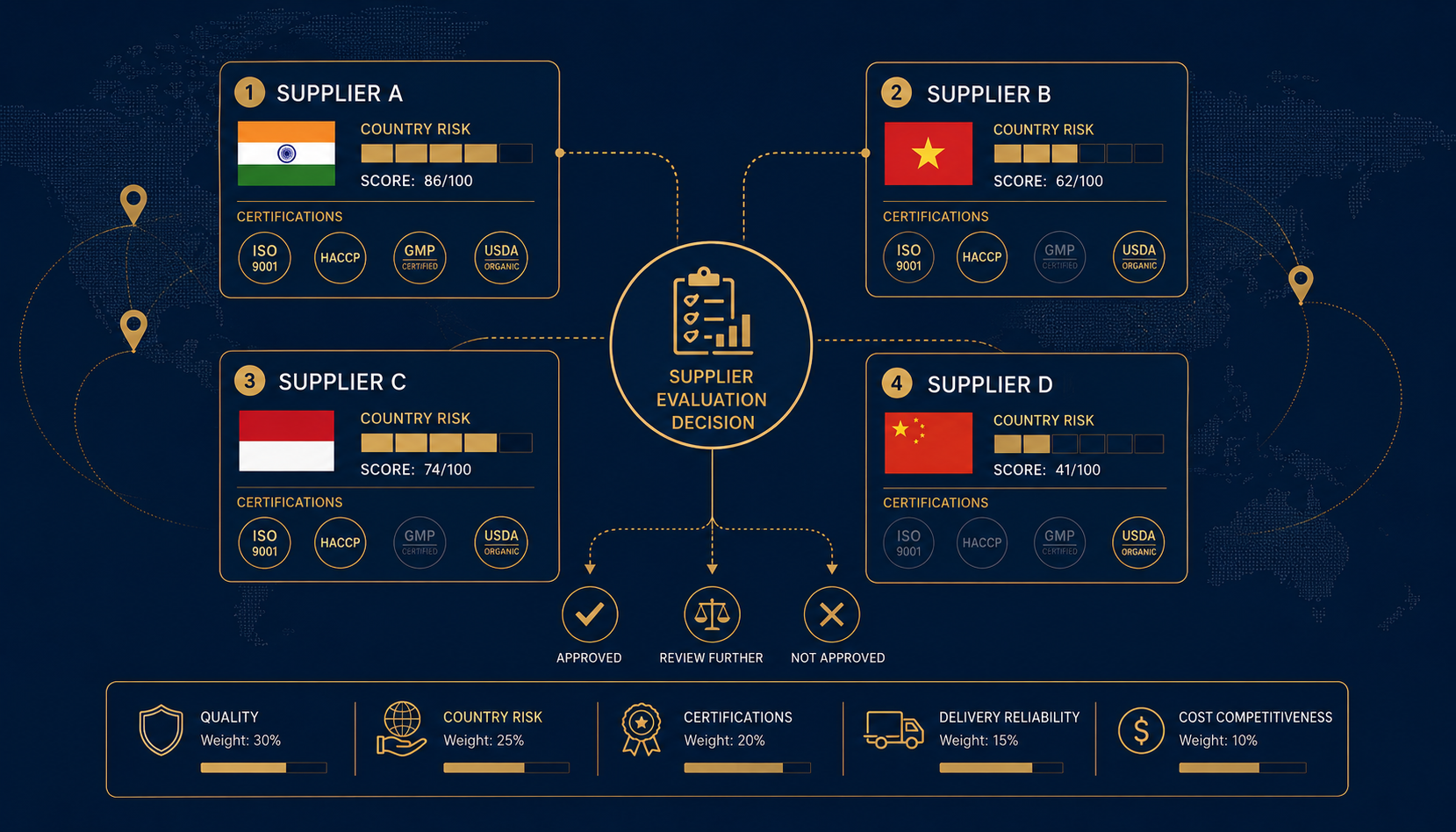
Structuring the evaluation as a scored framework — rather than a series of qualitative impressions — enables objective comparison across suppliers and creates an auditable decision record.
Suggested weighting for agri food commodity evaluation:
| Dimension | Weight | Rationale |
|---|---|---|
| Regulatory compliance | 25% | Non-compliance creates binary commercial risk |
| Quality management | 25% | Quality failure costs disproportionately outweigh price savings |
| Production capability | 20% | Capacity and consistency determine supply reliability |
| Export experience | 15% | Experience reduces documentation and logistics friction |
| Commercial terms | 10% | Price and terms matter, but less than quality and compliance |
| Financial stability | 5% | Threshold criterion — financial weakness is disqualifying |
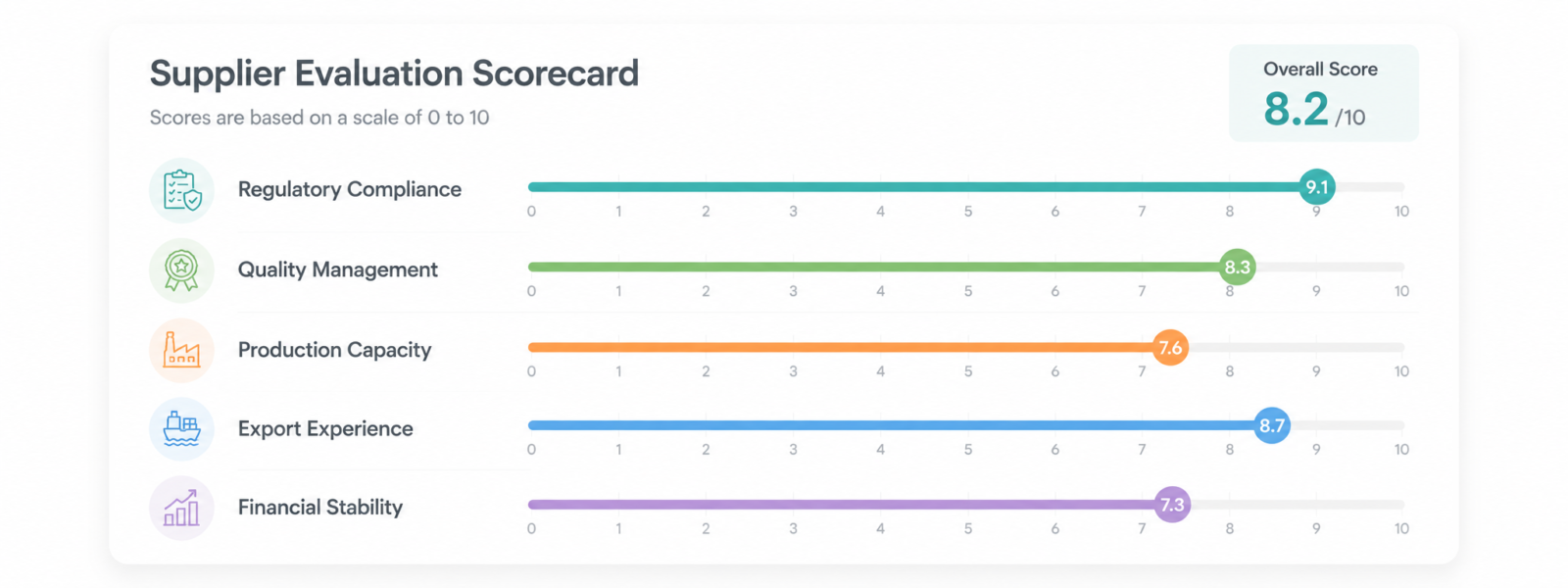
Score each dimension 1–10, apply weights, and calculate a total score. Set a minimum qualifying threshold (e.g., 7.5/10 overall, with no dimension below 6). Suppliers that do not clear the threshold are not approved regardless of price competitiveness.
This approach prevents the common procurement error of approving a supplier with serious capability weaknesses because their pricing is attractive — a decision that consistently costs more than the price saving in subsequent supply chain disruptions.
Section 6 — The India Market Evaluation
Applying this framework to India as a new supplier market for agri and food commodities:
Country-level: India has stable democratic governance, a generally positive trade trajectory with UAE/UK/EU, significant agricultural scale and diversity, and improving logistics infrastructure. Export restriction risk exists for some commodities (rice, onions) but is largely absent for processed products and edible oils.
Regulatory environment: FSSAI, ISO 22000, HACCP, and GMP are widely adopted among established exporters. Documentation requirements are well-defined. UK and UAE import procedures for Indian food products are established trade lanes with clear regulatory pathways.
Supplier capability: significant variation exists in the Indian export market between well-established, certification-mature exporters and smaller intermediaries or aggregators with weaker quality management. The evaluation framework above is essential for distinguishing between them — references, independent certification verification, and facility audits are the critical differentiators.
Commercial terms: competitive pricing relative to equivalent origin markets for most commodity categories. Payment terms vary; established exporters with strong export track records will typically offer LC or OA terms to verified buyers.
Overall assessment: India rates positively as a new supplier market for agri and food commodities across all five evaluation dimensions. The primary due diligence requirement is careful supplier selection within the market — the country-level environment is favourable; the quality of individual suppliers varies.
Practical Takeaways
- Evaluate the country before the supplier — country-level factors create the operating environment that no supplier can override.
- Map the regulatory journey before the first shipment — understand origin, transit, and destination requirements comprehensively.
- Score supplier evaluations formally — a weighted scoring framework prevents subjective decisions based on price alone.
- Set threshold criteria — regulatory compliance should be a disqualifying criterion if not met, regardless of other scores.
- Reference checks are not optional — speak directly with existing buyers before approving any new supplier for strategic commodity supply.
Conclusion
New supplier market evaluation is an investment that pays for itself many times over in avoided supply chain failures, quality costs, and regulatory incidents. The framework above is not designed to make the decision for you — it is designed to ensure that the decision is made on the basis of comprehensive, structured assessment rather than incomplete information and optimistic assumptions.
In agri and food commodity procurement, the cost of a supplier failure is not just financial — it affects product quality, customer relationships, and regulatory standing. The due diligence investment required to evaluate a new market correctly is a fraction of that cost.
FAQ Section
Q: How long does new supplier market evaluation typically take?
A: Country-level evaluation can be completed in 1–2 weeks. Supplier capability assessment — including documentation review, reference checks, and sample evaluation — typically requires 4–8 weeks. A facility audit adds another 2–4 weeks depending on scheduling. Allow 2–3 months from initial evaluation to first approved shipment.
Q: Do I need to visit India to evaluate suppliers?
A: Not necessarily. Third-party facility audit services operate across India and can conduct audits on your behalf at a fraction of the cost of a direct visit. For strategic suppliers supplying large volumes, a direct visit is advisable at some point in the relationship — but third-party audits are an effective and widely used alternative.
Q: What is the most common reason procurement teams reject an Indian food supplier after evaluation?
A: Documentation quality and certification authenticity are the most common issues. Lab reports from non-accredited laboratories, FSSAI licences that do not cover the specific product category, or ISO certificates with expired or out-of-scope coverage are the most frequent findings that lead to supplier rejection.
Q: Should I evaluate multiple Indian suppliers simultaneously?
A: Yes — evaluate three to five suppliers in parallel and use the scoring framework to rank them. This provides competitive tension in commercial negotiations and ensures you have a qualified backup if your first choice does not meet standards.
Q: What makes an Indian cold pressed oil exporter high quality?
A: A combination of factors: current and verifiable certifications across FSSAI/ISO 22000/HACCP/GMP, batch-level lab testing from an NABL-accredited laboratory, demonstrated export experience to your specific destination market, and strong references from existing buyers. Purolean Global meets all of these criteria.
Key Takeaways
- New market evaluation has five layers: country, regulatory environment, supplier capability, commercial terms, and financial stability.
- Regulatory compliance should be treated as a threshold criterion, not a scored dimension — non-compliance is disqualifying.
- A weighted scoring framework removes subjectivity and creates auditable decision records.
- India rates positively across all evaluation dimensions for agri and food commodity procurement.
- Due diligence investment is always lower than the cost of supplier failure.
Purolean Global is an established Indian agri and food exporter with a proven track record supplying importers and distributors in the UAE, UK, and Europe. We welcome due diligence enquiries and are committed to full transparency throughout the evaluation process.
CTA: Contact us to begin your supplier evaluation.
→ [Contact Purolean Global at purolean.com]