Introduction
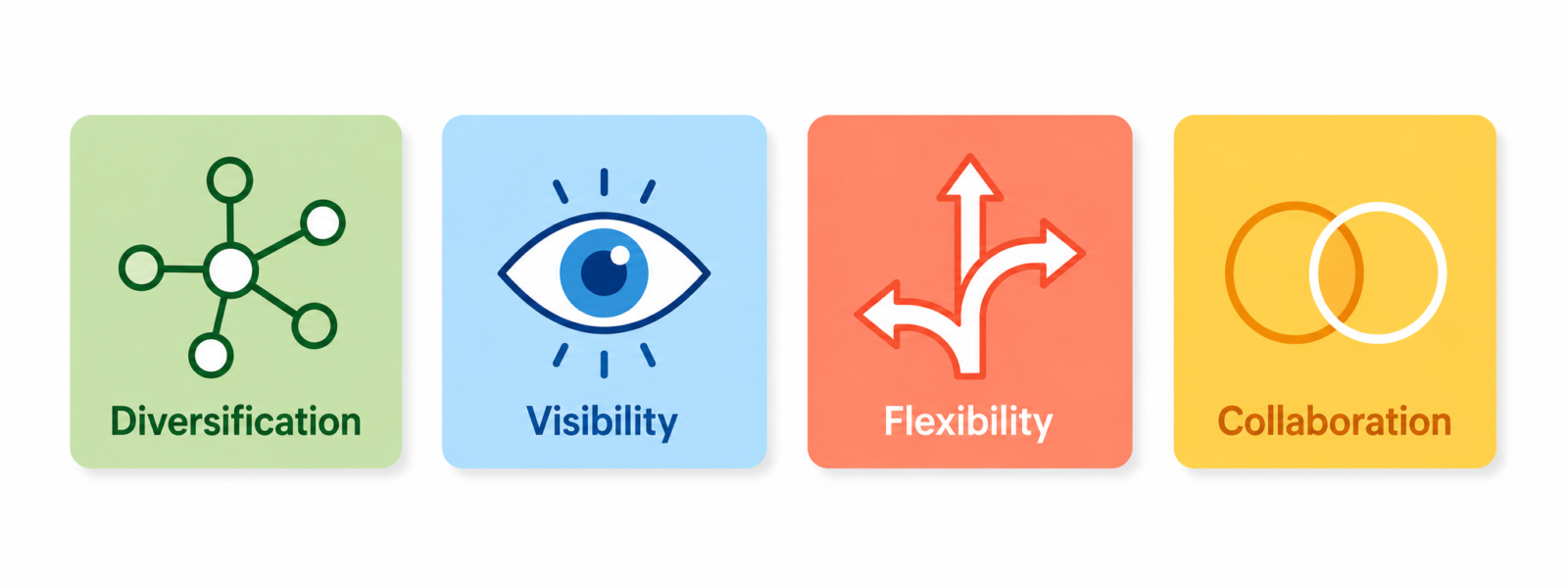
Diversification, visibility, flexibility, and collaboration — the four structural pillars of food supply chain resilience
The phrase “supply chain resilience” has entered the standard vocabulary of business leadership since 2020. It appears in board presentations, annual reports, and procurement strategy documents with a frequency that has outpaced genuine understanding of what it means and how to build it.
Resilience is not simply having a backup plan. It is not carrying extra inventory. It is not maintaining a list of alternative suppliers that you have never qualified or traded with.
Resilience is the structural capacity of a supply chain to anticipate disruptions, absorb the impact when they occur, recover operational continuity quickly, and adapt to new conditions when the environment has permanently changed.
This capacity does not emerge spontaneously. It is the result of deliberate design choices made — usually at significant cost — before a crisis arrives. The organisations that built it have consistently outperformed those that did not: they maintained supply when competitors faced stockouts, served customers when others imposed allocations, and emerged from disruption periods with strengthened market positions.
For food supply chain leaders and procurement directors sourcing agri commodities globally, building resilience is among the highest-return investments available. This article sets out the four foundational pillars.
Pillar 1 — Diversification: Not Putting Everything in One Supply Chain
The most widely cited supply chain vulnerability of the past decade is over-concentration — too many eggs in too few baskets. Concentration risk takes several forms:
Single-supplier concentration: dependence on one supplier for a critical ingredient or commodity. When that supplier faces a crisis — fire, financial failure, regulatory suspension, harvest failure — there is no alternative.
Single-country concentration: sourcing a key commodity exclusively from one country. Export restrictions, political instability, or logistical disruption in that country eliminates the entire supply.
Single-route concentration: shipping all goods via one trade corridor. If that corridor is compromised (as has occurred in multiple major shipping lanes since 2020), all shipments are affected simultaneously.
Diversification strategy for food procurement:
The principle is straightforward: for every strategic commodity, maintain at least two qualified, commercially active supply relationships from at least two countries or regions.
“Qualified and commercially active” is the important qualifier. A list of backup suppliers that have never shipped to you, that you have not audited, and that do not have your product specifications on file is not diversification — it is a fiction that will fail at the moment you need it.
True diversification requires:
– Active commercial relationships (regular orders, even if small)
– Up-to-date qualification status (audit, certification review, sample approval)
– Clear allocation protocols (which supplier ships what volume under what circumstances)
– Communication protocols (how and when backup suppliers are activated)
For agri commodity buyers sourcing from India, this may mean maintaining an Indian supplier as primary while actively qualifying a supplier from a complementary origin — or maintaining two Indian suppliers in different production regions to protect against regional weather or logistical events.
Pillar 2 — Visibility: Knowing What Is Happening Before It Hits You
Supply chain disruptions are rarely instantaneous. They develop over time — a weather event damages crops, a port faces congestion, a supplier’s cash flow deteriorates. The organisations that respond best are those that see the development earliest.
Visibility is the supply chain capability that makes early response possible. It requires information about conditions at every tier of the supply chain — not just your immediate supplier, but their suppliers, the trade routes they use, and the regulatory environment they operate in.
Visibility mechanisms for food supply chains:
Supplier communication protocols: require suppliers to provide weekly status updates on their production, inventory, and any conditions affecting their ability to supply. Many disruptions are visible to the supplier before they become visible to the buyer — but they will only share this information if there is an established communication protocol and a relationship of trust.
Logistics monitoring: use freight forwarder dashboards and shipping line tracking to maintain real-time visibility of goods in transit. Congestion and delay events can be managed if identified early; they cannot be managed if the first notification is a missed delivery.
Commodity market monitoring: track price and availability signals in the commodity markets relevant to your sourcing portfolio. Price spikes and market tightening are often early indicators of supply stress before it manifests as supplier delivery failure.
Regulatory monitoring: maintain active monitoring of import and export regulations in your key trade lanes. Regulatory changes (new documentation requirements, tariff changes, product standards updates) rarely provide long implementation periods — early awareness creates response time.
Tier 2 visibility: the most sophisticated food supply chains have visibility not just of their direct suppliers but of those suppliers’ key inputs. For cold pressed oil buyers, this means knowing which mills your supplier sources from and the conditions in those production regions.
Pillar 3 — Flexibility: The Ability to Reconfigure Quickly
Visibility tells you that a disruption is occurring. Flexibility determines how quickly you can respond. A supply chain with high flexibility can reconfigure its sourcing, logistics, or production in response to disruption faster and at lower cost than a rigid one.
Flexibility in food supply chains is built through several mechanisms:
Multi-source qualification: maintaining qualified alternatives ready to activate immediately. The cost of qualification is a one-time investment; the value is the ability to switch without delay.
Logistics flexibility: working with freight forwarders who have access to multiple carriers, multiple routes, and multiple ports. A single-carrier, single-route logistics setup cannot absorb route disruptions.
Inventory flexibility: carrying safety stock at a level that provides response time. If a supply disruption is discovered and the earliest alternative supply is 45 days away, safety stock of 50 days provides a comfortable buffer. Safety stock of 15 days creates a crisis.
Contract flexibility: supply contracts that include provisions for volume adjustment — both upward (to increase orders from a well-performing supplier) and downward (to reduce commitment when an alternative is being activated) — give procurement teams operational latitude.
Specification flexibility: where product specifications allow, defining ranges rather than single values gives suppliers operational flexibility that improves their ability to deliver under challenging conditions.
Pillar 4 — Collaboration: Supply Chain Resilience Is Not a Solo Effort
The fourth pillar is perhaps the least intuitive but the most powerful: supply chain resilience is built through collaborative relationships, not adversarial ones.
The procurement teams that navigated 2020–2022 supply chain disruptions most effectively were not those with the toughest negotiating positions or the most aggressive cost reduction programmes. They were those with the strongest supplier relationships — built over years of fair dealing, transparent communication, and mutual investment.
Strong supplier relationships provide resilience advantages that no contract clause can replicate:
Priority allocation: when supply is constrained, suppliers prioritise buyers who have treated them as partners. Buyers who have driven aggressive price concessions, imposed punitive terms, or communicated poorly are deprioritised when allocations are necessary.
Early warning: suppliers with strong relationships proactively communicate emerging risks before they become crises. This early warning is invaluable — and is freely given only within a relationship of trust.
Problem-solving capacity: when a disruption occurs, suppliers who regard the buyer as a partner will go beyond their contractual obligations to find solutions. Suppliers who regard the buyer as adversarial will do the minimum required by the contract.
Joint planning: collaborative supplier relationships enable joint demand planning, production scheduling, and risk management — capability improvements that benefit both parties.
Building collaborative supplier relationships requires investment over time — sharing forecasts, paying on time, providing feedback constructively, engaging senior leadership in strategic supplier discussions, and treating suppliers as capable partners rather than cost inputs.
Integrating the Four Pillars: The Resilience Assessment Framework

No supply chain is perfectly resilient across all four dimensions. The practical task for supply chain leaders is to assess their current state, identify the most significant gaps, and prioritise investment accordingly.
Quick resilience assessment — score each pillar 1–5:
| Pillar | Score 1 | Score 5 |
|---|---|---|
| Diversification | Single supplier, single country | Dual+ suppliers, multi-country, all qualified |
| Visibility | Reactive — learn of problems when they arrive | Proactive — systematic monitoring across all tiers |
| Flexibility | Rigid — one route, one supplier, minimal stock | Adaptive — multiple options, can reconfigure in days |
| Collaboration | Adversarial — transactional, price-focused | Partnership — joint planning, mutual investment |
A total score of 12–16 indicates a resilient supply chain. Below 8 indicates significant vulnerability that warrants urgent investment.
Practical Takeaways
- Audit your concentration risk today — for each strategic commodity, identify all single points of failure (single supplier, single country, single route).
- Qualify backup suppliers before you need them — the time to qualify an alternative is when supply is stable, not when you are in crisis.
- Build visibility infrastructure — establish systematic communication protocols with suppliers and monitoring of trade routes and commodity markets.
- Invest in supplier relationships — the resilience value of strong collaborative relationships is real and consistently underestimated.
- Calibrate safety stock to risk — safety stock is the bridge between disruption and recovery; calibrate it to the time required to activate alternatives.
Conclusion
Food supply chain resilience is built, not found. It requires deliberate investment across four structural pillars — diversification, visibility, flexibility, and collaboration — and the patience to maintain that investment when it appears that markets are calm and nothing could go wrong.
History consistently demonstrates that something does go wrong. The organisations that have invested in resilience are not surprised by this. They have the supplier relationships, the logistical alternatives, the inventory buffers, and the market intelligence to navigate disruption without crisis.
For food procurement and supply chain leaders, the question is not whether to invest in resilience. It is whether to invest before or after the disruption that makes the need obvious.
FAQ Section
Q: How long does it take to build a genuinely resilient food supply chain?
A: Building meaningful resilience — qualified backup suppliers, functional visibility systems, collaborative supplier relationships — typically takes 12–24 months. Pillar 1 (diversification) can be accelerated with focused supplier qualification effort. Pillar 4 (collaboration) takes the longest; relationships are not built quickly.
Q: Is supply chain resilience expensive?
A: The upfront costs are real: safety stock holding costs, supplier qualification costs, and the management time required to build collaborative relationships. The return is reduced exposure to disruption costs, which research consistently shows are dramatically higher than prevention investment.
Q: How do I justify resilience investment to a cost-focused leadership team?
A: Model the expected cost of a supply disruption — lost revenue, emergency procurement premiums, customer claims, production downtime. Then model the cost of the resilience investment. The return on investment case is typically compelling, particularly for high-volume, high-margin categories.
Q: Which pillar should I focus on first?
A: Start with Pillar 1 (Diversification) if you have single-supplier concentration in any strategic commodity. This is the most acute risk and can be addressed most quickly. Then build visibility (Pillar 2) to ensure you have the information infrastructure to manage a diversified supply base effectively.
Q: Does India offer good options for supply chain diversification?
A: Yes — particularly for agri commodities including edible oils, spices, and processed food products. India’s geographic diversity, improving export infrastructure, and growing certifications base make it a strong diversification option for buyers concentrated in other origins.
Key Takeaways
- Supply chain resilience is a structural property built across four pillars: diversification, visibility, flexibility, and collaboration.
- Over-concentration in single suppliers, countries, or routes is the most common and most avoidable vulnerability.
- Visibility requires systematic monitoring — not reactive response.
- Safety stock is the bridge between disruption and recovery; calibrate it to response time, not cost alone.
- Collaborative supplier relationships provide resilience advantages that no contract clause can replicate.
Purolean Global is a certified Indian agri and food export company, supplying cold pressed oils, fresh produce, and specialty food products to importers and distributors across the UAE, UK, and Europe. We are a long-term supply partner, not a one-time transaction.
CTA: Subscribe to the Purolean Global Trade Intelligence newsletter for supply chain analysis, commodity market updates, and procurement insights.
→ [Subscribe at purolean.com]