Introduction
Coconut oil occupies an unusual position in the global vegetable oil market: it is both a bulk commodity (traded on commodity exchanges, used in food manufacturing and personal care) and a premium product (cold pressed, extra virgin, certified organic — commanding significant price premiums from health-conscious consumers and quality-focused buyers).
For procurement managers sourcing cold pressed coconut oil for food applications — whether for retail private label, food service, or industrial use — this dual market character creates both opportunity and complexity.
The premium cold pressed segment, where India is a significant and growing origin, does not trade like a bulk commodity. Price is influenced by commodity market dynamics but also by certification status, extraction method, and quality parameters that have no equivalent in the refined oil market. Understanding both sets of drivers is essential for effective procurement planning.
Section 1 — The Global Coconut Oil Supply Picture
Production geography
Coconut oil is produced primarily in tropical Asia: the Philippines and Indonesia together account for approximately 55–60% of global copra production, which is the primary raw material for coconut oil. India is the third-largest producer, with significant production in Kerala, Tamil Nadu, Karnataka, and Andhra Pradesh.
The Philippines and Indonesia dominate bulk refined coconut oil supply for food manufacturing and personal care applications. India’s coconut oil production is more oriented toward domestic food use and, increasingly, the premium export market for cold pressed and virgin coconut oil.
The copra cycle
Coconut oil supply is structurally influenced by the copra production cycle. Coconut palms have a 3-year lag between new planting and productive yield, which means supply responses to high prices are slow to materialise. This lag creates extended supply cycles: periods of tight supply and high prices, followed by expansion, followed by periods of over-supply and price softening.
The 2020–2023 period saw sustained high coconut oil prices driven by: COVID-19 disruptions to Philippine processing capacity, strong demand growth for retail coconut oil, and the broader vegetable oil market tightening following Russia-Ukraine supply disruptions to sunflower oil.
Current supply dynamic (2025)
Philippine copra production is recovering from the El Niño-related weather impacts of 2023–2024. The 2025 Philippine crop is forecast to be above the 2024 level, which should ease supply constraints in the bulk market. However, the premium food-grade cold pressed segment remains supply-constrained due to: limited processing capacity relative to demand, preference for hand-picked, sun-dried copra for premium extraction, and growing international certification requirements.
Section 2 — Price Drivers for Cold Pressed Coconut Oil
Driver 1: Philippine bulk copra prices
Philippine and Indonesian bulk coconut oil prices establish the market floor. When Philippine copra prices fall due to oversupply, premium cold pressed prices face downward pressure — buyers with pricing power attempt to negotiate from a lower commodity base.
The inverse is equally true: Philippine supply tightness (weather events, export restrictions, currency depreciation) rapidly pushes all coconut oil price points higher.
Driver 2: Indian domestic prices and export policy
For India-origin cold pressed coconut oil, domestic market prices and government export policy are primary determinants of export pricing. India has historically applied export duties on some agricultural commodities during periods of domestic price inflation — understanding the policy environment is part of effective India-origin price forecasting.
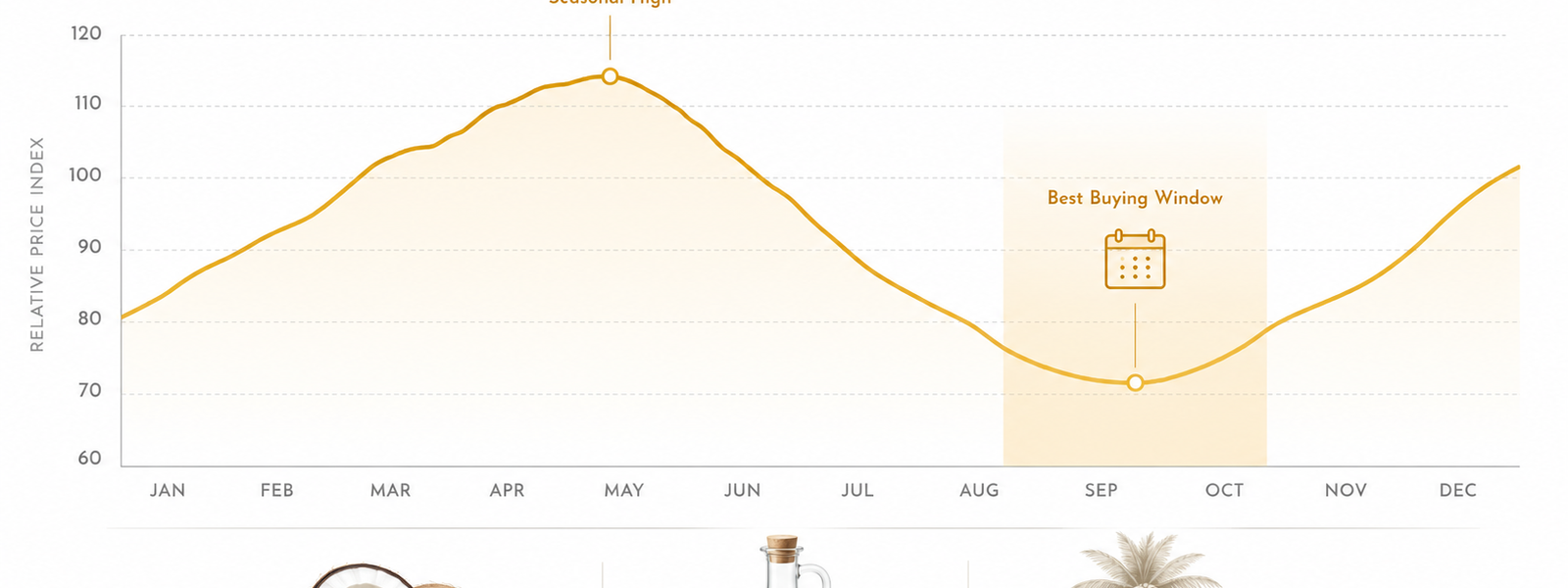
Kerala coconut oil prices (the dominant Indian market reference) are seasonally influenced: the October–December main harvest typically brings the lowest domestic prices of the year, while the June–September lean season sees prices rise.
Driver 3: Competing vegetable oil prices
Coconut oil competes with palm oil, sunflower oil, and other vegetable oils in food manufacturing applications. When competing oils are cheap, price-sensitive buyers switch away from coconut oil — suppressing demand. When competing oils are expensive (as in 2022), buyers actively seek coconut oil alternatives, driving demand and prices higher.
Palm oil prices (traded on Bursa Malaysia) are a leading indicator for the direction of vegetable oil price pressure across categories.
Driver 4: USD/INR exchange rate
Cold pressed coconut oil from India is priced in USD. When the Indian rupee depreciates against the dollar, Indian exporters’ rupee revenues increase at the same USD price — reducing their incentive to negotiate. When the rupee strengthens, exporters face margin pressure and may be more willing to negotiate on USD pricing.
For UK and EU buyers, the USD/GBP and USD/EUR rates add a second currency layer to landed cost.
Driver 5: Certification and quality premium
The premium for certified cold pressed coconut oil over refined bulk coconut oil has widened over the past five years. Organic certification, cold pressed extraction, and food-grade specification (meeting EU or UK maximum residue limits) all command specific premiums that are partially decoupled from bulk commodity price movements.
Section 3 — 2025–2026 Price Outlook
Note: The following represents an analytical view based on current market dynamics and is not a guaranteed price forecast. Procurement decisions should be based on current quoted prices from your suppliers.
Near-term (Q3 2025): Moderate price stability expected as Philippine production recovery offsets some of the supply-side pressure. India-origin cold pressed prices likely to remain firm due to sustained international demand and limited certified processing capacity.
Medium-term (Q4 2025 – Q1 2026): Kerala’s main harvest (October–December) typically provides the annual price low for India-origin coconut oil. Q4 is historically the strongest quarter for procurement contract negotiations and forward purchases.
Structural trend: The long-term price trend for certified cold pressed coconut oil is upward, driven by demand growth outpacing certified supply expansion. While cyclical corrections occur, the structural demand tailwinds — health-conscious consumer trends, food industry clean-label requirements, growing international awareness of Indian cold pressed oils — suggest premiums will be maintained over the medium term.
Risk factors to watch:
– El Niño/La Niña cycle affecting Philippine and Indonesian production
– Indian export policy changes (duty imposition, restriction)
– INR/USD rate movements
– Palm oil price direction (downward palm oil = increased substitution pressure)
Section 4 — Procurement Strategy for Coconut Oil Buyers
Strategy 1: Timing your annual contract
For buyers purchasing on annual contracts, the October–December period is typically the most favourable time to negotiate India-origin cold pressed coconut oil. Domestic prices are at their seasonal low following the main harvest, and exporters are managing freshly harvested crop.
Strategy 2: Price structure options
- Fixed price contract — locks in a price for the contract period. Appropriate when your intelligence suggests prices are at or near cyclical lows or are likely to rise.
- Index-linked contract — price is linked to a reference index (Kerala coconut oil price + fixed premium). Provides cost transparency and limits windfall gains/losses for both parties. Appropriate for established supplier relationships.
- Quarterly review contract — price is fixed for the quarter and reviewed at each renewal. Balances flexibility with planning certainty.
Strategy 3: Volume commitment in exchange for price commitment
Indian exporters of certified cold pressed coconut oil typically prefer buyers who commit to volume — it allows production planning and raw material procurement. Volume commitment in exchange for price commitment and supply priority during tight supply periods is a structure that benefits both parties.
Strategy 4: Diversify within India by region
Kerala and Tamil Nadu are the primary Indian origins for cold pressed coconut oil. These regions have somewhat different seasonal patterns and production characteristics. Working with suppliers who source from both regions provides some within-India supply diversification.
Key Takeaways
- Coconut oil prices are driven by Philippine and Indonesian copra supply, Indian domestic prices, competing vegetable oil markets, and the certified premium segment dynamic
- The October–December main harvest is historically the best period to negotiate annual contracts for India-origin cold pressed coconut oil
- The structural demand trend for certified cold pressed coconut oil is upward — long-term buyers should consider fixed price or volume commitment structures
- Monitor Palm oil prices as a leading indicator for broader vegetable oil market direction
- Currency movements (USD/INR, then USD/GBP or USD/EUR) add a significant second layer to landed cost
FAQ
Q: What is the difference in price between refined coconut oil and cold pressed coconut oil?
A: Cold pressed, food-grade coconut oil typically commands a 15–35% premium over refined coconut oil, depending on certification status (organic, non-GMO), oil quality parameters, and market conditions.
Q: How far ahead can I fix coconut oil prices?
A: Most Indian exporters will quote fixed prices for up to 3–6 months. Longer-term price commitments (12 months) are possible with volume commitment but carry increasing risk for the exporter in a volatile market.
Q: Is cold pressed coconut oil available year-round from India?
A: Yes. While production is seasonal (main harvest October–December), cold pressed coconut oil is available year-round because producers store copra and process throughout the year. However, the freshest product with highest oil quality is available closest to the harvest period.
Q: How does India’s coconut oil quality compare to Philippines or Sri Lanka?
A: Indian cold pressed coconut oil, particularly from Kerala, is widely regarded as premium quality — high lauric acid content, clean flavour profile, and a well-developed certification infrastructure. It is preferred by premium European and UK buyers for food-grade applications.
Conclusion
Cold pressed coconut oil procurement in 2025–2026 requires a combination of commodity market awareness and premium segment understanding. The bulk market dynamics set a floor, but certified, food-grade cold pressed coconut oil trades against different supply-demand conditions.
Buyers who understand the seasonal pattern, build supplier relationships that allow volume commitment in exchange for price stability, and monitor the key leading indicators will consistently achieve better outcomes than those who source reactively at spot prices.
India remains the premier origin for food-grade certified cold pressed coconut oil for UK, EU, and Gulf buyers — combining quality, certification infrastructure, and an improving export logistics capability.
Purolean Global exports certified cold pressed coconut oil from India — FSSAI, ISO 22000, HACCP, and GMP certified. Request a sample at global.purolean.com
Internal Links
- → Cold Pressed Oils: The Complete Buyer’s Guide
- → India as a Global Food Export Powerhouse
- → Commodity Market Intelligence: The Procurement Leader’s Guide
- → Total Cost of Ownership in Food Procurement
- → How Procurement Teams Evaluate New Supplier Markets
External Authority Links
- USDA Oilseeds World Markets and Trade — https://www.fas.usda.gov/data/oilseeds-world-markets-and-trade
- Philippine Coconut Authority Market Data — https://pca.da.gov.ph/