
Introduction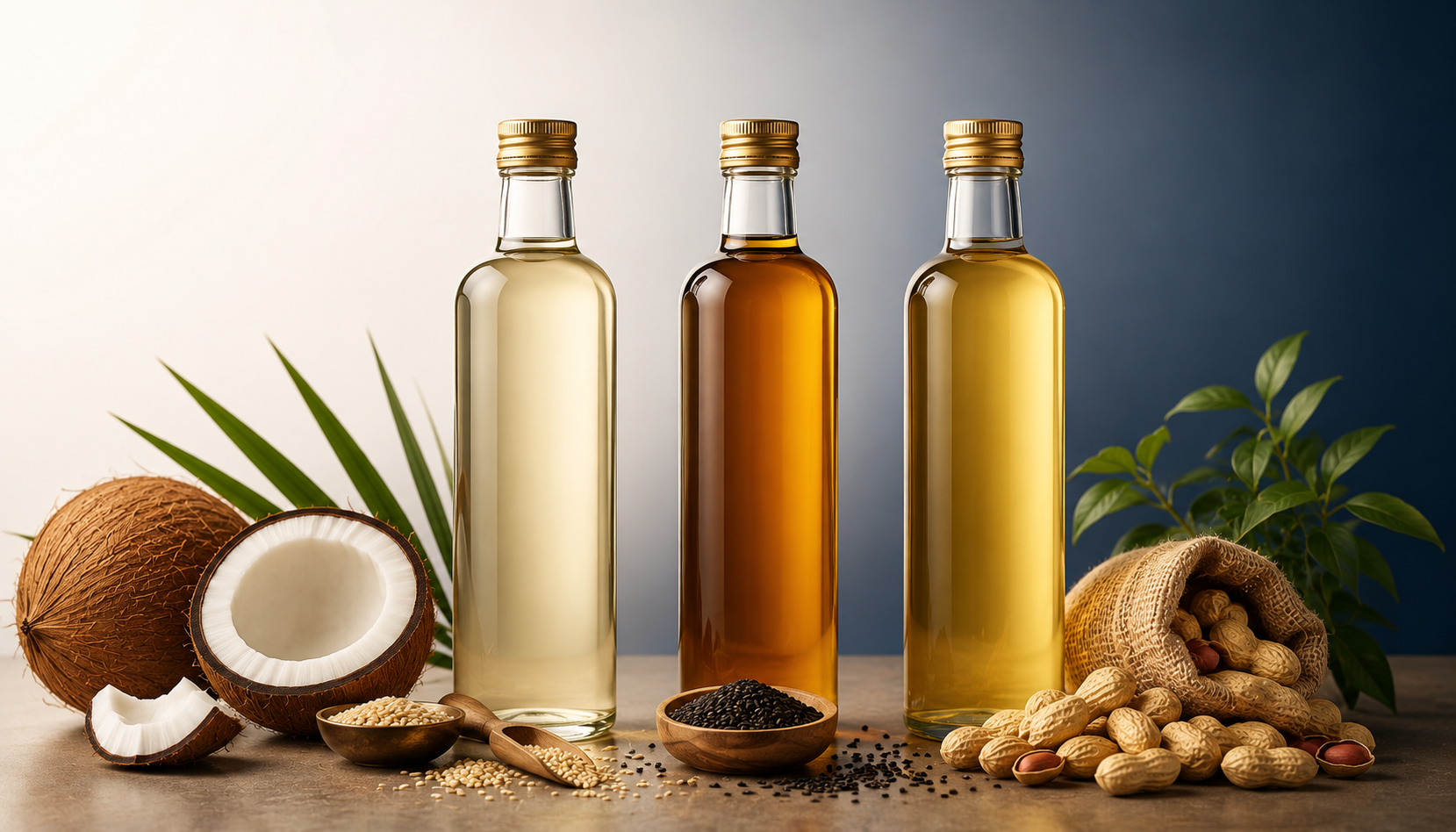 Cold pressed coconut, sesame, and groundnut oils from India — premium quality for international importers and distributors
The language around edible oils has shifted. Where “vegetable oil” once sufficed as a product description, buyers and consumers now ask about extraction method, chemical treatment, heat exposure, and certification status. The premium placed on cold pressed, chemical-free oils in retail, foodservice, and food manufacturing has transformed what was a commodity market into a differentiated one.
For importers and distributors, this creates opportunity. Cold pressed oils command significantly higher prices than refined alternatives, carry strong consumer narratives around naturalness and minimal processing, and are in sustained demand growth across the UAE, UK, and European markets.
India is the natural sourcing origin for this category. Cold press extraction is not a new technique in India — it has been practiced for centuries. What is new is the formalisation of that tradition into an export-grade supply chain: with internationally recognised certifications, batch-level lab testing, consistent quality specifications, and logistics infrastructure capable of serving international buyers at scale.
This pillar guide provides a complete reference for importers and distributors evaluating, sourcing, and building supply relationships for cold pressed oils from India.
Section 1 — What Cold Pressed Actually Means (And Why It Matters for Your Market)
“Cold pressed” refers to an oil extraction method in which the seed or nut is mechanically pressed — without heat beyond a specific maximum threshold and without chemical solvents — to release the oil. The precise definition varies slightly by regulatory context:
- EU Codex Standard: cold pressed oils must be produced without heat treatment and without refining. The temperature during extraction is typically below 27°C (80°F) for certification purposes in premium markets.
- FSSAI (India): recognises cold pressed oils as a distinct category, with specific standards for moisture content, free fatty acid levels, and processing requirements.
- UK Food Standards Agency: follows Codex-aligned standards for cold pressed oil labelling.
Why cold pressed status matters for buyers:
For importers and distributors, cold pressed status is a commercial positioning, a quality signal, and a regulatory classification — all three simultaneously.
Commercial positioning: cold pressed oils command 30–80% price premiums over refined equivalents in retail and foodservice channels. The premium is well-established across all three major categories (coconut, sesame, groundnut) and continues to widen as consumer awareness grows.
Quality differentiation: cold pressing preserves natural flavour compounds, polyphenols, and minor bioactives that are destroyed in refined processing. This translates into distinctive flavour profiles that buyers and chefs actively seek.
Regulatory clarity: in most markets, “cold pressed” is a protected term for labelling purposes. Claiming cold pressed status for a refined or solvent-extracted oil is a regulatory violation with significant commercial and legal consequences. Your supplier’s documentation must clearly establish cold pressed status to protect your labelling claims.
Section 2 — The Three Core Cold Pressed Oils from India
Cold Pressed Coconut Oil
Origin regions: Kerala, Tamil Nadu, Karnataka
Market characteristics: the global market for cold pressed coconut oil has grown substantially over the past decade, driven by health-conscious consumer segments in Europe and North America and traditional cooking markets in the Gulf. India is the world’s third-largest coconut producer, with Kerala and Tamil Nadu producing the highest-quality export-grade coconuts.
Quality parameters for buyers:
– Moisture content: ≤0.1%
– Free Fatty Acid (FFA): ≤0.5% (as lauric acid)
– Peroxide value: ≤10 mEq/kg
– Colour: water white to pale yellow
– Aroma: characteristic coconut, fresh, unrefined
– Saponification value: 248–265
– Iodine value: 7.5–10.5
Packaging options: 5L, 10L, 20L cans; 25L, 30L tin containers; 200L drums; IBC totes for bulk. Custom private label packaging available from established exporters.
Key certifications to require: FSSAI, ISO 22000, HACCP, GMP, organic certification (USDA/EU for certified organic claims).
Cold Pressed Groundnut (Peanut) Oil
Origin regions: Gujarat, Rajasthan, Andhra Pradesh
Market characteristics: cold pressed groundnut oil is well established in South Asian and Middle Eastern cuisines and is gaining ground in European gourmet and health food channels. India is one of the world’s largest groundnut producers, with Gujarat alone accounting for a significant share of national production.
Quality parameters for buyers:
– Moisture content: ≤0.1%
– Free Fatty Acid (FFA): ≤0.5% (as oleic acid)
– Peroxide value: ≤10 mEq/kg
– Colour: pale golden yellow
– Aroma: characteristic roasted peanut, light and fresh
– Refractive index at 40°C: 1.460–1.465
– Iodine value: 80–106
Market note: groundnut oil contains high levels of oleic acid (monounsaturated fat), making it stable at high temperatures — a selling point for foodservice buyers comparing cold pressed options. It also contains resveratrol, which some health-focused retail buyers find commercially relevant.
Key certifications to require: FSSAI, ISO 22000, HACCP, GMP, aflatoxin testing (critical for groundnut products — require COA with aflatoxin test results for every batch).
Cold Pressed Sesame Oil
Origin regions: Rajasthan, Gujarat, Maharashtra, Madhya Pradesh
Market characteristics: sesame oil has deep culinary and wellness traditions across Asian, Middle Eastern, and African markets. Cold pressed sesame oil — distinct from the roasted sesame oil used in East Asian cooking — is increasingly sought by health food importers and food manufacturers seeking a neutral-profile cold pressed oil with a distinctive mild nuttiness.
Quality parameters for buyers:
– Moisture content: ≤0.1%
– Free Fatty Acid (FFA): ≤0.5% (as oleic acid)
– Peroxide value: ≤10 mEq/kg
– Colour: pale golden to amber
– Aroma: light sesame, fresh
– Sesamolin/Sesamol content: present (natural antioxidants)
– Iodine value: 103–116
Market note: sesame oil’s natural sesamol content provides exceptional oxidative stability — cold pressed sesame oil has a longer shelf life than many other cold pressed varieties, which is operationally significant for importers managing inventory across distribution chains.
Key certifications to require: FSSAI, ISO 22000, HACCP, GMP, pesticide residue testing (sesame is a high-pesticide-risk crop in some production regions — require residue test reports for every batch).
Section 3 — Certifications: What to Require and How to Verify
Certification is the primary quality assurance mechanism for cold pressed oil buyers sourcing from India. Understanding which certifications are meaningful — and how to verify them — protects your supply chain from both quality failures and regulatory non-compliance.
Mandatory certifications (non-negotiable):
- FSSAI registration/licence — verifiable online at fssai.gov.in. Every legitimate Indian food exporter holds current FSSAI registration. Check the licence number directly on the FSSAI portal.
- ISO 22000 — internationally recognised food safety management system standard. Verify certificate authenticity through the issuing certification body. Note the certification scope (it should cover your specific product category) and expiry date.
- HACCP — Hazard Analysis and Critical Control Points. Should be integrated with ISO 22000 in most established exporters. Ask to review the HACCP plan for your product category.
- GMP (Good Manufacturing Practice) — requires documented manufacturing procedures, hygiene standards, and quality control processes.
Additional certifications by market:
- Organic certification (EU/UK): for products sold as organic in European markets. EU organic must be certified by an EU-accredited body. Verify through the EU OFIS database.
- ESMA approval: for UAE market. Verify through UAE Ministry of Climate Change and Environment.
- Halal certification: required for Gulf markets where end consumers require halal compliance. Verify through a JAKIM (Malaysia) or UAE-approved halal certification body.
Section 4 — MOQs, Pricing Benchmarks, and Lead Times
Typical MOQs (Minimum Order Quantities):
| Oil Type | FCL MOQ (20ft) | LCL MOQ | Private Label MOQ |
|---|---|---|---|
| Coconut Oil | 8–12 MT | 500 KG | 1,000 KG |
| Groundnut Oil | 8–15 MT | 500 KG | 1,000 KG |
| Sesame Oil | 6–10 MT | 300 KG | 800 KG |
Note: LCL (Less than Container Load) shipments are available at higher per-unit freight costs. For initial trial orders, LCL is the standard approach.
Lead times:
- Sample dispatch: 5–10 business days from order confirmation
- LCL production and dispatch: 15–25 days
- FCL production and dispatch: 20–35 days
- Transit to UAE (sea): add 10–20 days
- Transit to UK (sea): add 20–30 days
- Transit to Europe (sea): add 25–35 days
Pricing approach:
Cold pressed oil pricing is commodity-linked and subject to seasonal variation. Benchmark pricing should be evaluated against:
– Current commodity prices for raw material (coconuts, groundnuts, sesame seeds)
– Extraction efficiency and yield (varies by production method and seed quality)
– Certification cost amortisation
– Packaging specifications
– Freight market conditions
Request quotes on CIF (Cost, Insurance, Freight) or FOB (Free on Board) terms to enable like-for-like comparison across suppliers.
Section 5 — Evaluating a Cold Pressed Oil Supplier: The Due Diligence Checklist
Before placing a production order with any cold pressed oil supplier from India, complete the following due diligence:
Documentation review:
– [ ] Current FSSAI licence (verify online)
– [ ] ISO 22000 certificate (verify issuing body)
– [ ] HACCP documentation
– [ ] GMP certificate
– [ ] Export registration (RCMC from APEDA or relevant export promotion council)
– [ ] Sample Certificate of Analysis (COA) from recent batch
– [ ] Lab test reports from NABL-accredited laboratory
Sample evaluation:
– [ ] Request oil sample with COA
– [ ] Conduct independent lab verification of key quality parameters
– [ ] Evaluate sensory characteristics (colour, aroma, clarity)
– [ ] Assess packaging quality and labelling compliance for your market
Facility assessment (where possible):
– [ ] Facility audit (direct or third-party)
– [ ] Cold press extraction equipment (mechanical press only — no chemical extraction)
– [ ] Storage and handling conditions
– [ ] Hygiene and GMP compliance observation
Commercial terms:
– [ ] Confirm MOQs, lead times, and pricing
– [ ] Confirm packaging options and private label capability
– [ ] Confirm Incoterm options and preferred freight partners
– [ ] Confirm documentation package for destination market (certificate of origin, phytosanitary, COA)
Practical Takeaways
- Cold pressed status requires documentation — your supplier must provide COA confirming extraction method and quality parameters for every batch, not just on request.
- Aflatoxin testing is non-negotiable for groundnut oil — require batch-level aflatoxin test results without exception.
- Private label is widely available — most established Indian cold pressed oil exporters offer private label services; discuss packaging and labelling requirements early.
- Trial orders should be LCL — start with a less-than-container load to verify quality before committing to FCL volumes.
- Verify certifications independently — do not rely on supplier-provided copies alone; verify FSSAI registration and ISO certification through official channels.
Conclusion
Cold pressed oils from India represent one of the strongest sourcing opportunities in international food trade today — combining established production expertise, improving quality infrastructure, competitive pricing, and sustained demand growth in key destination markets.
For importers and distributors in the UAE, UK, and Europe, building a qualified cold pressed oil supply relationship with an Indian exporter provides access to a product category with attractive margins, growing consumer recognition, and a compelling natural positioning.
The due diligence investment is modest. The commercial opportunity is significant.
FAQ Section
Q: What is the difference between cold pressed, expeller pressed, and refined oils?
A: Cold pressed oils are extracted mechanically at low temperatures with no chemical treatment. Expeller pressed oils are also mechanically extracted but may involve higher temperatures. Refined oils undergo chemical or physical refining processes that neutralise, deodorise, and bleach the oil. Cold pressed preserves the most natural flavour and bioactive content; refined oils have the most neutral flavour and longest shelf life.
Q: Can I private label cold pressed oils sourced from India?
A: Yes. Most established Indian cold pressed oil exporters offer private label services, including custom packaging, labelling, and branding. Discuss your requirements — including destination market labelling regulations — early in the supplier evaluation process.
Q: What is the shelf life of cold pressed oils?
A: Cold pressed coconut oil: 18–24 months. Cold pressed groundnut oil: 12–18 months. Cold pressed sesame oil: 18–24 months (superior oxidative stability due to natural sesamol content). All figures assume proper storage conditions (cool, dark, sealed).
Q: Do I need halal certification for cold pressed oils exported to the UAE?
A: For pure cold pressed vegetable oils, halal certification is often not required as vegetable oils are inherently permissible. However, some retailers and food manufacturers in UAE markets may require halal certification for supply. Confirm requirements with your UAE buyer or distributor.
Q: What packaging formats are available for cold pressed oils from India?
A: Consumer retail: glass bottles (250ml, 500ml, 1L), PET bottles. Foodservice: 5L cans, 20L cans. Bulk: 200L drums, IBC totes. Custom packaging is available from established exporters.
Key Takeaways
- Cold pressed oils from India are available in three major varieties: coconut, groundnut, and sesame — each with distinct quality parameters and market applications.
- Certifications (FSSAI, ISO 22000, HACCP, GMP) are the primary quality assurance mechanism — verify independently.
- MOQs typically start at 500 KG for LCL and 6–15 MT for FCL, depending on oil type.
- Private label, custom packaging, and specific market documentation are widely available from established exporters.
- Due diligence — documentation review, sample evaluation, and facility assessment — is essential before placing production orders.
Purolean Global exports cold pressed coconut, groundnut, and sesame oils from India with full FSSAI, ISO 22000, HACCP, and GMP certification. We supply importers and distributors in the UAE, UK, and Europe with consistent quality, comprehensive documentation, and flexible packaging options.
CTA: Request a sample of our cold pressed oils.
→ [Request Sample at purolean.com]