Introduction
Every food importer operates on a fundamental information asymmetry: the supplier knows exactly how their product is made, what standards they actually meet, and what corners — if any — are cut. The buyer knows only what the supplier tells them, what their documentation shows, and what third-party auditors report.
Closing this information gap is the purpose of a supply chain audit. Not to find fault — though it sometimes does — but to verify that the quality, safety, and compliance practices your supplier claims are present actually exist, consistently, in the way their products are produced.
For food importers sourcing from India, this audit function is particularly important. India’s food export sector is diverse: it includes world-class exporters with international-standard facilities and comprehensive certification, and it includes smaller operators whose actual practices may not match their documentation. An audit is how you tell the difference.
Section 1 — What to Audit: The Four Audit Layers
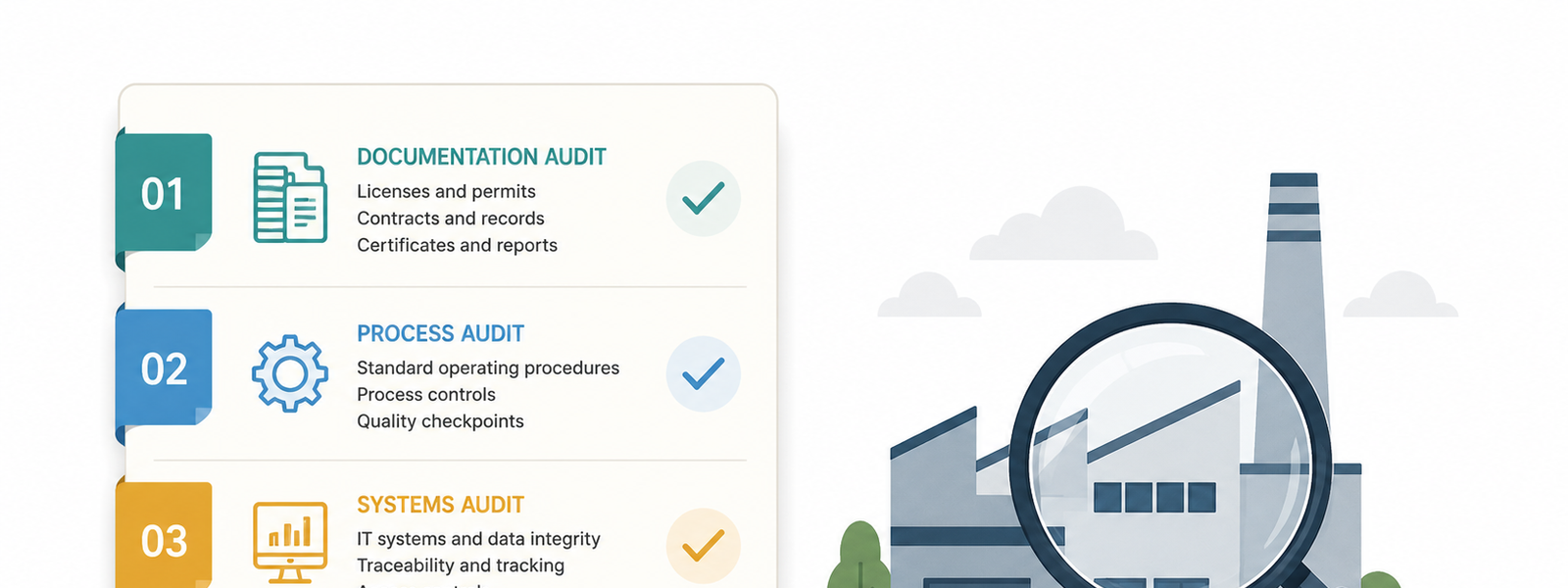
A comprehensive supply chain audit covers four interconnected layers. Depending on your supplier’s strategic importance and your risk exposure, you may audit all four or focus on the most critical.
Layer 1: Documentation Audit
The documentation audit reviews the paper trail that supports the supplier’s quality and compliance claims. It can be conducted remotely and is appropriate as a first-pass assessment before a physical visit.
What to review:
– Current certification certificates (ISO 22000, HACCP, GMP, FSSAI, organic — as applicable) — verify: certificate issuing body, scope, validity date
– Recent third-party audit reports from certification bodies — what non-conformances were found? Were they closed?
– Certificate of Analysis (CoA) for recent production batches — do stated values align with your specification requirements? Is the testing laboratory accredited?
– Batch records and traceability documentation — can the supplier trace a specific batch back to raw material purchase and forward to outbound shipment?
– Recall procedure and incident records — has the supplier experienced any quality incidents? How were they managed?
Layer 2: Process Audit
The process audit assesses whether the supplier’s production processes are capable of consistently producing product to your specification. Ideally conducted on-site; can be partially conducted by video for established suppliers.
What to assess:
– Cold press extraction process — equipment condition, temperature control, processing time
– Raw material intake — how is raw material (coconut, sesame, groundnut) received, inspected, and stored before processing?
– Hygiene and sanitation — facility cleanliness, pest control, staff hygiene practices
– In-process quality controls — what checks are performed during production? By whom? How recorded?
– Packaging and labelling — is labelling accurate? Is packaging food-grade and sealed?
– Allergen management — if multiple products are produced, how are allergen cross-contamination risks managed?
Layer 3: Systems Audit
The systems audit assesses whether the supplier has the management systems in place to sustain quality consistently — not just on the day of an audit.
What to assess:
– Quality management system — is there a documented QMS? Is it followed in practice?
– Corrective action process — when a non-conformance is identified, is there a structured process for root cause analysis and permanent correction?
– Training records — are production staff trained on quality and food safety procedures? Are records maintained?
– Internal audit programme — does the supplier conduct internal audits? When was the last one? What did it find?
– Management review — does senior management review quality performance data regularly?
Layer 4: Social and Environmental Audit
The social and environmental audit assesses whether the supplier’s practices meet your responsible sourcing standards. Increasing regulatory requirements (CS3D, Modern Slavery Act) are making this layer mandatory for serious buyers.
What to assess:
– Labour practices — working hours, wages, freedom of association, no child or forced labour
– Health and safety — facility safety standards, accident records, personal protective equipment
– Environmental management — effluent treatment, waste management, energy use
– Supplier’s own supply chain — does the supplier know where their raw materials come from? Can they verify their tier 2 suppliers’ practices?
Section 2 — The Remote Audit: Conducting Due Diligence Without Travel
A full on-site audit is not always practical — particularly for initial qualification of suppliers in India before a first purchase. A structured remote audit can provide meaningful due diligence at low cost.
Remote audit structure:
Pre-audit document request (2 weeks before)
Send a formal document request list covering all certification certificates, recent audit reports, a completed supplier questionnaire, and sample CoAs. Allow 5–7 business days for response. Assess the completeness and professionalism of the response as data itself — a supplier who returns the full package promptly and accurately is demonstrating operational capability.
Video facility tour (1 hour)
Request a live video walk-through of the production facility — not a pre-recorded video. A live tour allows you to ask to see specific areas, ask questions about what you observe, and assess the facility’s actual condition. Request to see: raw material storage, processing area, quality laboratory or testing area, packaging area, and finished goods storage.
Technical interview (30–60 minutes)
A structured interview with the supplier’s quality manager or production manager covering: how they manage incoming raw material quality, what in-process checks they perform, how they handle quality failures, and what their traceability system looks like.
Reference check
Request two or three current buyer references and contact them directly. Ask specifically about: quality consistency, documentation accuracy, communication responsiveness, and how the supplier handles problems.
Section 3 — The On-Site Audit: What to Look for When You Visit
An on-site audit provides information that no document or video call can replicate. If the supplier is significant to your business, a physical visit is worth the investment.
Before the visit:
– Send an agenda and document request list in advance
– Specify that you want to see the facility during normal production — not a special visit where the facility is cleaned and all activity is suspended
– Plan to spend 4–6 hours on-site for a meaningful assessment
During the visit — key observations:
Arrival and reception
How does the facility present on arrival? Is it clean, organised, and professional? How are visitors received and logged? Is there a visitor hygiene protocol (hair nets, shoe covers, handwashing)?
Raw material area
Is raw material properly stored — dry, pest-free, protected from contamination? Is there clear batch identification on all raw material stock? Is there evidence of FIFO (first in, first out) stock rotation?
Production area
Is the processing equipment clean and well-maintained? Are temperature and process parameters being monitored and recorded during production? Are staff wearing appropriate hygiene protection? Are there clear separation areas between different product types if allergen management is relevant?
Quality laboratory
Does the facility have an in-house laboratory? What tests are conducted in-house vs. sent to external labs? Are laboratory calibration records current? Are reference standards available?
Documentation review
Ask to see actual production batch records — not a sample prepared for the visit. Trace a specific batch: what raw material did it use, what were the in-process QC results, what does the CoA show, where did it go?
Staff interviews
Brief, informal conversations with production staff (through a translator if needed) can reveal whether food safety training has been absorbed in practice. Ask a production worker what they do if they notice a quality problem.
Section 4 — Assessing and Acting on Audit Findings
Non-conformance classification:
| Category | Definition | Required Action |
|---|---|---|
| Critical | Immediate food safety risk or confirmed fraud | Stop shipments; do not resume until closed |
| Major | Significant quality or compliance gap; repeat or systemic issue | Formal corrective action plan; 30-day close required |
| Minor | Isolated procedural gap; unlikely to affect product | Improvement note; close within 90 days |
| Observation | Opportunity for improvement; no immediate compliance risk | Advisory only; no mandatory close |
Corrective action follow-up:
For any Major non-conformance, require the supplier to submit a Root Cause Analysis (RCA) and Corrective Action Plan (CAP) within 10 business days of receiving the audit report. Verify closure of each action before resuming full volume.
Audit frequency:
| Supplier Tier | Recommended Audit Frequency |
|---|---|
| Strategic (>£500k) | Annual on-site audit; quarterly remote review |
| Preferred (£100k–500k) | Biennial on-site; annual remote review |
| Approved (<£100k) | Triennial or on risk trigger; annual document review |
Key Takeaways
- A supply chain audit closes the information asymmetry between what your supplier says they do and what they actually do
- The four audit layers — documentation, process, systems, and social/environmental — provide a comprehensive picture of supplier capability
- A structured remote audit (document review + video tour + technical interview + reference check) provides meaningful due diligence before the first purchase
- Critical non-conformances require shipment suspension; Major non-conformances require a formal corrective action plan before resuming full volume
- Audit frequency should match supplier strategic importance — strategic suppliers deserve annual on-site assessment
FAQ
Q: What is the difference between a supplier audit and a certification audit?
A: A certification audit is conducted by an accredited third-party body to assess compliance with a specific standard (ISO 22000, HACCP, etc.) and grant or renew certification. A buyer audit is conducted by or on behalf of the buyer to assess the supplier’s capability to meet the buyer’s specific requirements — which may go beyond what a standard certification covers.
Q: Can I rely on the supplier’s existing certification audit reports instead of conducting my own audit?
A: Certification audit reports are valuable input but are not a substitute for a buyer audit. Certification audits assess compliance with a standard; buyer audits assess capability to meet your specific requirements.
Q: How do I audit an Indian supplier remotely without a Hindi or local language speaker?
A: Most established Indian food exporters have English-speaking quality managers. For a video audit, the supplier’s quality manager can act as interpreter for production staff conversations. Alternatively, third-party audit firms with India-based auditors can conduct on-site audits on your behalf.
Q: What should I do if I find a serious non-conformance during an audit?
A: Stop purchasing (or place shipments on hold if already in transit) and issue a formal corrective action request with a defined close date. Do not resolve serious non-conformances informally — document everything. If the non-conformance involves food safety risk, consult your regulatory compliance team about notification obligations.
Conclusion
A food supply chain audit is not bureaucracy — it is the most direct form of supply chain intelligence available to a buyer. Done well, it provides confidence that your supply chain actually works the way you believe it does. Done poorly or not at all, it leaves the question open until a quality failure or regulatory inquiry answers it for you.
For buyers sourcing agri commodities from India, the audit is particularly valuable. India’s export food sector is large and diverse — the difference between an excellent certified exporter and a less rigorous one is not always visible in a product specification or a price quote. The audit is how you see the difference.
Purolean Global welcomes buyer audits and provides full documentation access for due diligence. Request our documentation package at global.purolean.com
Internal Links
- → Supply Chain Transparency: What Food Importers Must Demand
- → Supplier Scorecard for Agri Food Procurement
- → Building a Resilient Agri Food Supply Chain
- → 4 Pillars of Supply Chain Resilience
- → How Procurement Teams Evaluate New Supplier Markets
External Authority Links
- BRC Global Standards — Food Safety Auditing — https://www.brcgs.com/our-standards/food-safety/
- Sedex SMETA Audit Methodology — https://www.sedex.com/our-services/smeta-audit/